The wheels of the plane rudely touched down in Baku and yanked me from an uncomfortable sleep. As the dimmed lights from the ceiling burned through my dry eyes, awareness of my surroundings gradually came back. I found myself in a seat of a plane. People around me were gathering their things while the plane slowly rolled through the runway dotted with bright orange lights. Some lo-fi music was playing quietly from the ceiling. From all this, it was clear that the plane had landed, and that I had arrived in Azerbaijan.
I might have pushed myself too hard by roughing it without accommodation the other day. I hadn’t had proper rest or even taken a shower since leaving Samarkand. But I couldn’t help it. For every day that passed, my obsession with reaching Dublin on time only grew. How long could I afford to stay in Baku? I was thinking I could just spend one day to save time. But Kostya’s suggestion from Uzbekistan echoed in my head: “One day in Baku? I think that’s too short. You will need a couple of days to see Baku.” So I was open to the idea of staying a bit longer. But first, I needed to wait for the sun to come up. It was barely past five in the morning and everything was asleep.
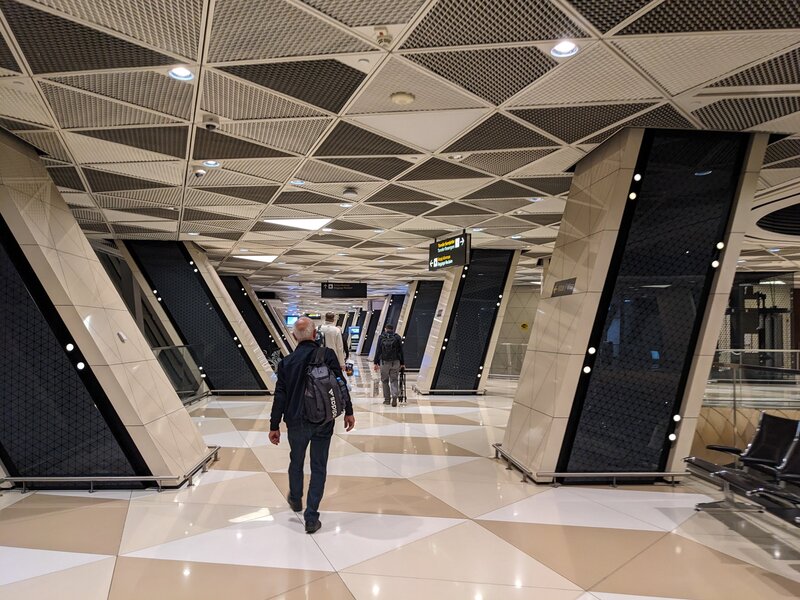
At this hour, only emptiness prevailed in the sleek airport hallways surrounded by abstract and modern designs. After the crowd from the plane had gone on their separate ways, the airport felt so empty that even the overwhelming silence wasn’t enough to fill the vacuum. I roamed the empty terminal looking for a place to rest. I eventually set down my backpack on an empty bench near some closed departure gates. A few travelers were sleeping or resting nearby in the oppressive emptiness that lingered in the night airport. As I got busy looking at the map and picking out places to visit, an incessant scrape broke the silence behind me. An old man was trying to charge his phone, but his cable wouldn’t fit into his phone. I didn’t have any spare cable, because I needed to charge up my electronics, too. So I suggested to him that we take turns using my USB cable. He thanked me and sat down nearby after plugging in his phone. We exchanged a few words and got to know each other. We discovered that we both spoke Russian and switched into it.
The old man’s name was Ivan and he was from Ukraine. He said he used to drive trucks in Kharkiv but was out of work due to the ongoing conflict. Ivan was here to visit his son who lived in Azerbaijan and was waiting for the daylight before heading into the city. “Ty zdes’ ran’she byval?” Ivan asked (“Have you been here before?”). “Nyet, pervi raz. Prosto puteschestvovat” (“No, first time. Just travel”). “Baku krasivyy. Obyazatel’no posmotri gorod” (“Baku is beautiful. Be sure to check it out”). He asked where I was going next, and I explained my plan to reach Dublin, and he listened with interest. While we were busy talking, the dawn started slowly breaking. Ivan’s phone was all charged up, and I plugged in mine to prepare to leave for the city soon. I wasn’t sure where to even go, but at least I had found a hostel near the center. I thought I’d just walk in, drop my backpack, and start from there. Ivan helped me buy a bus ticket to the city, and we both hopped on the bus, leaving the impeccably modern and empty airport behind. The morning was shaping up to be cloudy.
The bus was going straight toward the city center, but I got off at some random subway station two-thirds of the way there. It was partly because the map showed it was faster to take the subway into town. But the main reason was that I wanted to check out Baku’s subway. I wondered whether it was going to be as epic as the Tashkent metro, and what kind of regional touches were added on top of the Soviet monumentalism. The bus was getting more and more crowded, and I couldn’t even see Ivan or say goodbye to him before hurriedly hopping off to beat the huge line of oncoming passengers.
When I walked up to the station, I was greeted by its modern and abstract facade fully covered with glass. The platforms and underground passages were just as stylish. The over-the-top aesthetics of Tashkent metro were not really here. Anyway, it turned out to be a weekday, and the morning rush hour traffic was filling up the platform. I’d made a mistake getting off that bus. When a subway train arrived and its doors opened, hardly anyone could get on because the cars were already full. There was simply no way I could squeeze in with my oversized backpack. After letting a couple of trains pass, I gave up and took another bus to the city instead.
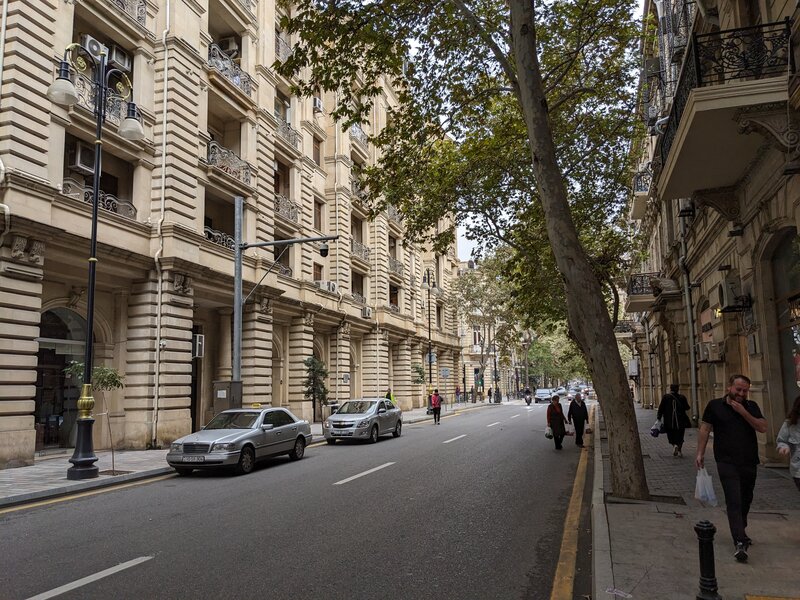
The rush hour bus wasn’t much better than the subway but at least I could fit myself in. The passengers glanced curiously at the scruffy backpacker at first, but soon went about their business. The bus traveled in silence for about half an hour to reach the city center. My first impression of the city was that the streets were so calm and tidy. After coming from a more chaotic and lively Central Asia, the calm took some getting used to. I strolled past charming brick buildings and walked into the hostel. There were actually a few other hostels in the area, but I just picked a random one because I was too tired to overthink it. The owner was nice about my early arrival and let me drop off my backpack. There was no one in the common area as everyone was probably asleep. I headed back out to get something to eat and check out the city. Since I might have only one day in Baku, every moment was precious.
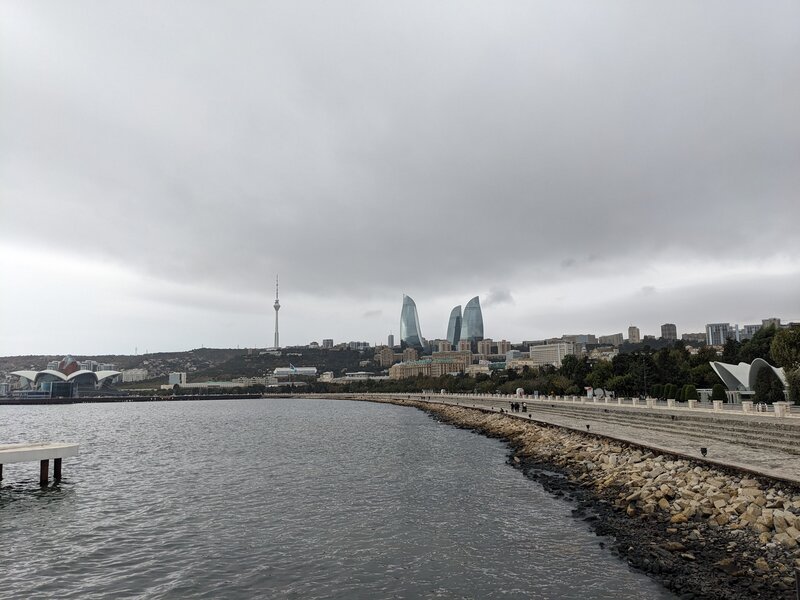
Near the city center was a park that stretched for miles along the shoreline. Only a few people were out, and the place was roaring with the strong wind from the sea. It was only later that I learned of Baku’s moniker, the city of winds. This passionate wind was speaking of Baku’s character in the most fitting way, but I had no way of knowing this at the time. Beyond the shoreline stretched the Caspian Sea, so vast I couldn’t take it in. How far would I have to swim or sail to reach the part of the world that lay beyond? I stopped and stared at the sea, far into the direction from which I had come. The salt-laced wind turned bitter. Okay, this time I flew over it, but next time I’d do it the hard way. The unrelenting wind and the waves were daring me. The water, the deserts, and the mountains were waiting in the distance unknown.
When I turned away from the winds that were drying my eyes, the iconic Flame Towers were standing far away on top of the hill under the gray sky. Since I didn’t have any particular place to be, I started walking toward them. But the walk didn’t last long. Only a few minutes in, I realized my legs were so heavy and my mind was as cloudy as the sky above me. Fatigue was finally hitting me like a ton of bricks. The past few days were rough but doable, but the straw that broke the camel’s back was the red-eye flight and practically getting no sleep. I kept sitting down on benches along the empty promenade, but couldn’t muster up the energy to reach those Flame Towers on foot. I turned back to the hostel to take a quick nap and recover.
After leaving the quiet seafront, I happened to be walking across the old city. There were many old buildings and brick-paved streets. The area seemed too interesting to pass by, no matter how tired I was. So I pushed through and trudged along the beautiful streets of the old city, my heavy legs protesting every step. But as I climbed a winding and steep hill, I began to question whether there was a point. All the structures and streets that had just appeared charming and authentic started feeling somewhat artificial. The problem was yet again the perfection. Everything was so carefully packaged and presented in its prettiest form, just as it had been in Uzbekistan. After seeing a certain number of fancy restaurants masquerading as historic landmarks and tour guides trying to persuade me to join their groups, my curiosity dwindled. I just got back to the hostel and lay down for an hour.
My head became much clearer after the nap. But the mind was still burdened with many urgent questions such as whether I was going to leave Baku the following day, where my next destination should be, and how I was going to get there. Tbilisi was the most likely candidate for my next stop, as it was conveniently on my way west. But I wasn’t sure how to get there most efficiently, as the direct train was suspended at the time. What complicated the matter more was my unrealistic expectation of visiting other cities on my way there. After all, the lesson from the barren steppes of Western China was still fresh in my mind: not to approach life in terms of trade-offs, but instead to do everything that it threw at me. Even with a clearer mind, it was hard to think through it all. I figured I’d worry about it in the evening.
I couldn’t come up with many ideas for things to do. I had already lost interest in all the perfectly presented streets and pretty buildings around me. Kostya’s suggestion to check out Yanar Dag or the mud volcanoes came to mind. But it was already late in the afternoon, and it didn’t seem possible to visit all those places. Then I remembered a picture that Sakoto had sent me the night before. She was the one who drew whiskers on my face during our Uno game at the hostel in Samarkand. I was messaging her while bored out of my wits and half-asleep in the Tashkent airport. She had sent me a message that read, “There are some interesting things in Baku I want to find,” and along with it was a picture of a giant Soviet-era mural depicting astronauts ascending to space. I had forgotten about it, but realized trying to find that piece of art would be more interesting than walking and taking pictures of the city’s immaculately presented streets.
My search began in the Heydar Aliyev Center whose curvy white walls were gleaming under the bright afternoon sky that was finally clearing up. That thoroughly modern structure seemed to be the furthest thing from any Soviet murals. If that mural existed at all, it must have been at home on the side of some five-story concrete apartment building. But downtown Baku didn’t show even the slightest hint of the region’s Soviet past. Instead, the buildings and streets were screaming something modern and abstract, as if to prove a point. The locals also didn’t know where the random mural could be found in Baku. Some police officers simply asked me in return, “Muzey? Kak nazyvayetsya etot muzey?” (“Is this a museum? What’s the museum called?”), assuming it was some display at a museum. A cyclist and a taxi driver tried to help me out, debating at length about where it could possibly be. They were smiling the whole time, probably wondering why this tourist wouldn’t just go into Heydar Aliyev Center like he was supposed to. They asked me whether I was completely sure it was in Baku, and told me that, if it were really in Baku, it would be near the old town or one of the museums near there. I made my way back to the old town.
The traffic was really bad and when I arrived in the old town, all the fancy museums were closed. Disconcerted, I walked around the nearby neighborhoods looking for places where the mural might be. There were none. Everything was so modern and stylish and had no room for such relics. It was not until later that someone told me that I’d have to go to the far outskirts of Baku to see the kind of five-story Soviet apartment buildings or murals.
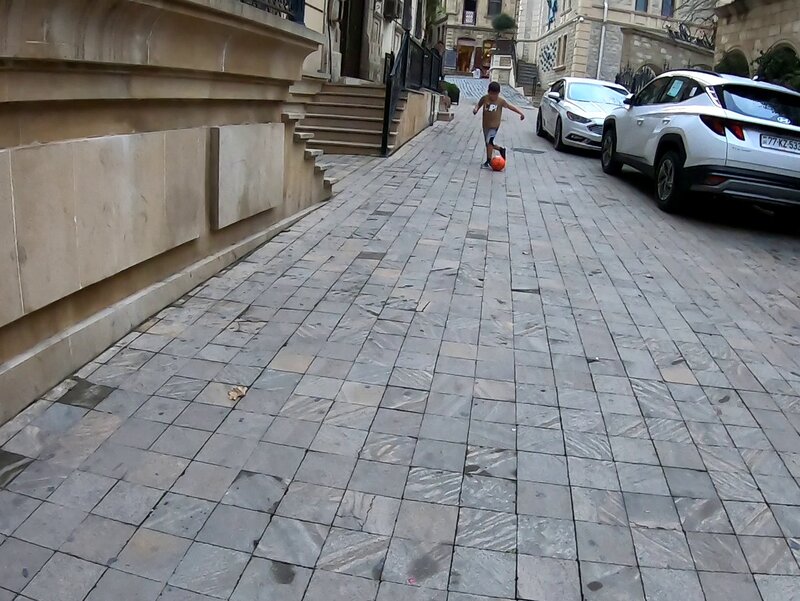
When I was walking in a quiet street, there was a local kid kicking a soccer ball alone against the wall. He passed me the ball. We didn’t exchange any words, but for the next few minutes we kicked around the ball. The kid had some skills and was pulling off some clever tricks. When we were done, I felt my time in Baku was done. The beautiful city of Baku had much more to offer, but my eccentric distaste for everything that was perfect didn’t allow me to appreciate what the city had in store. Still, I decided to give it one more day to check out Yanar Dag and the mud volcanoes as Kostya suggested. When I got back to the hostel that evening, Sakoto and her friends had messaged me they had arrived in Baku as well. “We can meet in Baku,” she said. “By the way, are you sure that mural is in Baku? I wanna find it but couldn’t,” I wrote, tongue-in-cheek. “Yes I am sure,” the answer went, “maybe tomorrow we can find it together.” I wasn’t sure there would be enough time to hunt for the mural the following day.
The evening was settling on the pretty streets of Baku. It was finally the time to deal with the problem that I had been putting off all day: where would I go next? Overwhelmed by the gravity of the question, I went into the dorm room to get my laptop to start doing some research. While I was sorting out my belongings, a fellow traveler and I randomly started chatting. We talked about our impressions of Baku, and how long we had been in the city.
From the way he spoke, I thought he might be from Korea, but wasn’t too sure. Eventually, the traveler dropped a question: “Where are you from?” and we discovered we were both Koreans. So I initiated the awkwardly timed switch to our native language, which was a bit strange at first but certainly broke the ice. The traveler’s name was Gunn, and he too had just arrived in Baku this morning. Actually, it turned out we were both on the same 3:20AM flight from Tashkent. “Wait, aren’t you tired?” we asked each other and realized we both knew the answer all too well.
Gunn had a story that somehow resonated with mine. For many months, he had been traveling toward his final destination of Vienna to see the Christmas market. Compared to his trip of epic proportions, my rushed campaign toward Dublin felt almost too casual. Still, our footsteps were mirrored, though in different places and timelines. In the lonely pursuits of the places that beckoned us, our paths happened to coincide in that fleeting moment. I wanted to ask Gunn why he was headed toward the Christmas market, of all the places in the world. But I didn’t want to burden the conversation with a subject that I feared could spiral into something philosophical so fast. After all, I myself didn’t know the reason that I was headed to Dublin or what it all meant. For the first time, this lack of clarity started to bother me. I started asking “Why?” I wondered whether it was the same for Gunn.
As we were talking about what our plans were in Baku, Gunn said, “I’m going on a tour to check out Yanar Dag, the mud volcanoes, and a few other places.” “Oh, really?” I exclaimed, “I was going to check them out tomorrow.” Gunn said he had found a tour guide that would take a group of people through a bunch of places outside Baku. Gunn said he himself didn’t usually join guided tours either, but was giving it a chance because it was probably the most economical use of time since he was also leaving Baku soon. It was pretty hard to argue with that logic, given my dilemma of fitting seemingly infinite places into a limited timeline. I decided to embrace the conveniently packaged and served experience that I was quick to dismiss, and join forces with Gunn to explore the outskirts of the city. Sakoto and her friends weren’t too sure about joining us, but said they were also probably going to leave Baku for Georgia in two days.
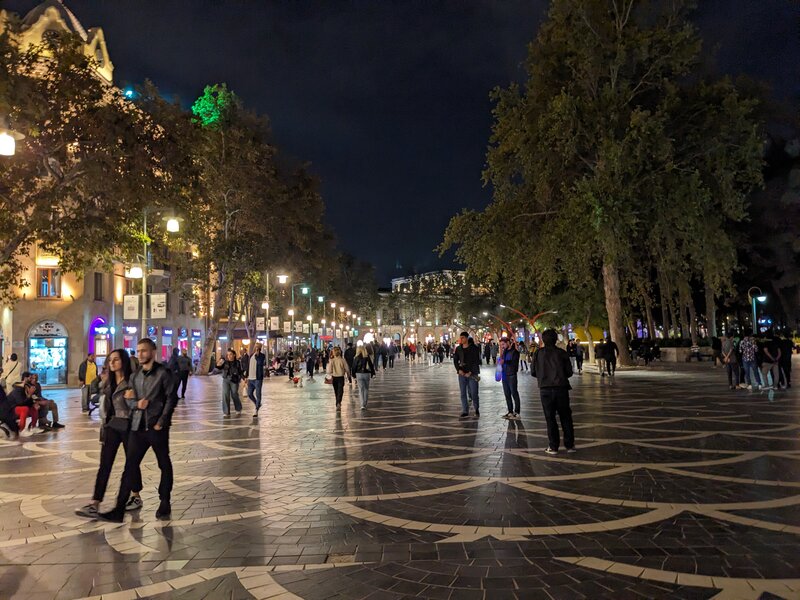
When I went outside to get some dinner, the sky was already dark and the autumn night had fallen on the pretty streets. On the avenues and squares whose names I didn’t know, I tried to blend into the night crowds. Suddenly, a realization hit me that everything here took on a slightly different touch from that in Central Asia. As I slowly made my way farther west, the architecture, the appearances of people, the temperature, and even the smell of the autumn air were again all changing. It was the first time since passing through Xinjiang that I observed a noticeable shift. On this side of the Caspian Sea, mosques were still mosques, buildings were still buildings, and people were still people, but all in slightly different ways. It was a welcome sign that I was making progress. An open question was whether I could keep moving fast enough. At this thought, I returned to the hostel to start planning.
For the next few hours, I went through many possible combinations of destinations and tried to make them fit together in the remaining eleven days. I concluded it would be better to head straight to Tbilisi without stopping at other cities. The reason was that the route from Istanbul to Dublin wasn’t as straightforward as I hoped it’d be. The biggest hurdle was that the train ticket from Istanbul to Sofia couldn’t be booked online in advance. Rather, I had to go to a ticket office at a train station in Istanbul in person and hope that the tickets were still available. The road onwards from Bulgaria was equally uncertain. Given all these moving parts, the best course of action was to make for Istanbul as fast as I could. So I booked a train ticket from Baku to Aghstafa, a town in the western part of Azerbaijan which was 500km (310mi) away from Baku. Although it was still 100km (60mi) away from Tbilisi, it was the closest to Georgia I could reach by train. I didn’t have a particular plan for how to get to Tbilisi from there, but figured I’d work something out. Explore the outskirts of Baku tomorrow, then leave for Tbilisi the day after–that sounded like a plan.
Later in the evening, Gunn came over to the tiny corner table where I was immersed in the planning. The loud noise of a nearby washing machine filled the bleak space. We got talking again and the subject naturally drifted to our upcoming plans. Gunn was keen on getting to Sheki, a town also located near the Georgian border in the western part of Azerbaijan. When I told him I was leaving for Tbilisi the day after tomorrow, Gunn was surprised that I was leaving Azerbaijan so soon. It was then that I explained my plan to reach Dublin in the next eleven days. Gunn thought about the plan for a bit, and said rather incredulously, “Bro, that might not work out.” I admitted I was honestly just scrambling toward Istanbul and hoping for the best. As a fellow traveler, Gunn spoke with genuine care, trying to explain why the plan wasn’t realistic. I knew well that he was correct, but I wasn’t prepared to listen to the reason. Sometimes we just want to take a leap of faith.