“Beijing Capital,” read the display above the boarding gate. I was unsure. The departure hall buzzed with anticipation of the boarding call, but I felt out of place. Why was I doing this? I’d always thought the reason didn’t matter to me. But taking the actual first step, I panicked. Nothing assured me that the road ahead really led to Dublin, and I feared that I would face my inevitable failure and disappointment. Besides, I couldn’t explain to myself why I was even boarding the flight to Beijing when I was really supposed to be going to Seattle. Visiting my uncle the other day in South Korea also made me question the whole thing. His illness was more serious than I had expected, and the relatives were in a grim mood. I didn’t know if taking off to follow some absurd idea was the right thing to do instead of being there for them.
That’s where my head was at as the twenty-four-day countdown toward Dublin was beginning. It was the morning of October 5, and I needed to be in Seattle by October 28, meaning I had to reach Dublin earlier than that. The distance to cover appeared unfathomable, the idea felt absurd, and the doubt was fresh. Whatever excitement the boarding announcement managed to stir was short-lived. As the plane took to the clouds, doubt reared its head again, whispering the question I couldn’t answer–why.
The thought of ending up in Beijing without knowing why suddenly felt scary. I needed to form some kind of answer to the question of why. By the time the plane started descending, this is what I came up with: I was going there because I wanted to. It came down to a choice–I had made a decision to buy this plane ticket and be in this seat. The explanation wasn’t convincing, but it was still better than nothing. After flying over an ocean dotted with small landmasses, the plane passed endless wind farms on the shore of China and vast mountains and agricultural fields. China was closer than I had thought. In no time, the plane was overlooking industrial areas and concrete high-rise apartments that showed their age with their grim colors. The plane landed at ten o’clock. The airport was massive, and there were only a few other foreigners at immigration. Some Russian families and Japanese tourists were lined up at the passport control labeled “The Belt and Road Lane.”
While waiting in line, I was bracing myself for tough questions because I had listed Xinjiang as one of the destinations in the immigration card. And I hadn’t even bought a ticket out of China, nor did I have any accommodation booked except the first night at some random hostel in Beijing. To add to the anxiety, I wasn’t sure how the whole visa-free scheme for Australians was going to work out. China had announced it just a few months earlier, and there was little information about how it worked in practice. Even when I was boarding the flight in Seoul, I was held back at the gate because the airline insisted that Australians needed a visa to enter China, until they made several long phone calls to be convinced otherwise. The line slowly moved forward, and soon it was my turn. The immigration officer signaled me over and gave a brief stare-down. He flipped through my passport and the immigration card a few times. He asked, “First time in China?” I said yes, and thunk! the passport was stamped. After clearing customs, I downloaded a payment app, which took a good twenty minutes on my slow internet connection. According to the limited English-language information available, I apparently needed it to pay for anything in the country. With some help from the people around me, I used it at a vending machine to buy a train ticket toward the city center. It was mildly exciting, and I even felt curious about what awaited me in the city.
But when I got to the city and the day went on, I realized that something was off. I was overwhelmed by the urgency that I needed to be constantly moving to cover the distance ahead. It would take me a couple of days to get into the rhythm of the trip and know how to live with that urgent feeling. Moreover, I couldn’t shake the thought of my ailing uncle and the worried relatives. With all this weighing on me, everything around me felt just wrong, and the things that usually didn’t bother me began to grate on my nerves. The streets seemed unwalkable, the traffic was heavy, the air wasn’t clean, and I was hungry and didn’t know where or what to eat. And virtually no one spoke English. The state of the room at the hostel added to the distress. It was unkempt, with little sunlight or ventilation, reeked of cigarettes, and had a sick person on the top bunk coughing and spitting every ten seconds. All this made me want to move on from Beijing already. I wasn’t even sure that I could, because it was the national holiday known as Golden Week, and all the train tickets were selling out rapidly.
I forced myself to check out a few places near the city center, but that didn’t help me calm down. My rushed footsteps didn’t really take me anywhere because I had underestimated the scale of things in China. Everything was truly massive, and there were just so many people everywhere. The streets roared with the sound of the crowds all talking at the same time. To make matters worse, many roads were closed with checkpoints because of Golden Week, making it more difficult to navigate the madness. Exhausted and disheartened, I found myself at an enormous security checkpoint near Tiananmen Square. After some confused looks when I presented my foreign passport to the police officers, they started talking and eventually let me through after a pat-down. Tiananmen Gate itself was closed, but impressive buildings surrounded Tiananmen Square, bustling with enormous crowds flowing in and out. I didn’t know what those buildings were, and at that point, didn’t even want to know. All I could think of was the incomprehensible distance I had to cover and the relatives I’d left behind in Korea. The sound of the crowd was deafening, and I just wanted out.
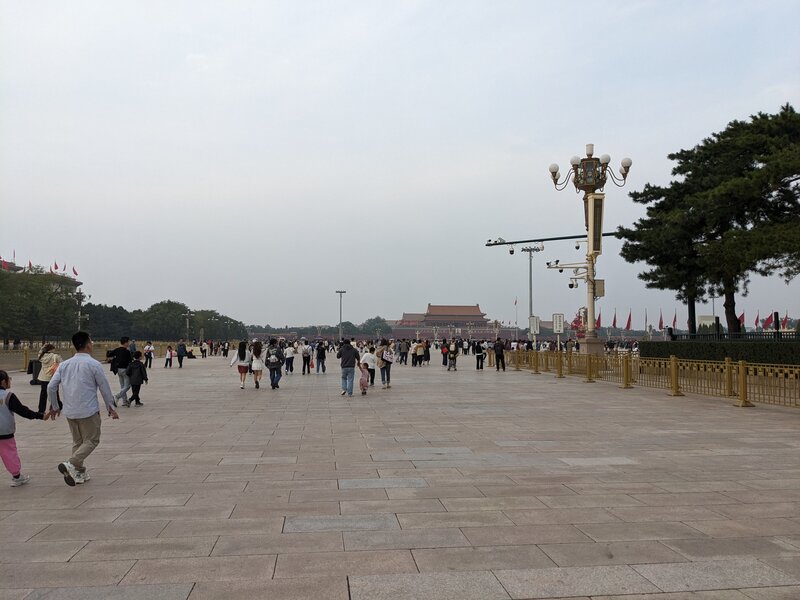
My legs were tired. I was dehydrated, agitated, and hungry. I just wanted to go back to the hostel and reserve a train ticket out of the city before it sold out. But navigating the closed streets and checkpoints ate up a good chunk of time, so it was already dark when I got back. I didn’t know where to have dinner. Everything looked extremely spicy or salty. The hostel wasn’t in a very touristy area either, so the options were rather limited. I finally ordered some dry noodles at a random restaurant but could barely finish half. After that, all I wanted to do was take a shower, but I couldn’t buy a towel because no one would accept cash and the payment app was having issues verifying my passport. While I was standing around baffled by the fact that I needed a passport to use a vending machine, a local student helped me pay for it.
I finally sat down and started planning my next move. Under different circumstances, Beijing would have been an interesting city to explore, but my heart just wasn’t in it. Since it was only the first of many stops leading to the final destination, I couldn’t afford to just stay put and wait to regain my composure. So I decided to just leave, after a stop at the Great Wall and the Forbidden City. But the tickets for the Forbidden City had been sold out for days. This news didn’t even disappoint me because I didn’t really care anymore. But I could still get to the Great Wall. So the plan was to go to the Great Wall the following day, and catch a sleeper train to Xi’an that night.
Around nine o’clock, fighting the urge to sleep, I booked a bus to the Great Wall. The pickup was at 8:00AM the next morning, at some place far from the hostel. And I also managed to book one of the last remaining train tickets to Xi’an for the following evening. During Golden Week, I was lucky any tickets were left at all. I was anxious the whole time I was booking the ticket, because of the slow internet and glitchy payment app. Any issue would have ruined my plan for escaping the city. When I was done, it was already past midnight, and the next day promised no rest. I had to make an early start to go to the pickup point, and also pack up and check out in the morning because I was leaving the city that night. All the stress and planning wore me out. I had nothing left. I set the alarm and fell asleep hungry.