The cold wind was just as menacing on this side of the border. The scarce moonlight reflected off a dirt road leading to nowhere. I had no idea how to find shelter or transport for the night. Two border officers were standing around in the distance, so I walked over and started talking to them. They confirmed that there was pretty much nothing in the area, and that I would need to travel to another town to find a place to stay for the night.
They asked where I was headed, and I replied without hesitation that I was going to Osh. Osh was actually a town quite far from Irkeshtam, located close to the border with Uzbekistan–the country I had in mind as the next destination. My answer surprised the officers and they kept telling me, “Osh daleko” (“Osh is far away”). They suggested I’d be better off heading to the nearest village of Sary-Tash. But their sensible advice again fell on deaf ears. I needed to cover as much ground as possible because the path ahead was riddled with unknowns. I naively thought if I could reach Osh that night, I’d be able to make my way into Uzbekistan the next day and knock off an entire day from the trip.
With only seventeen days to go, I had time for just one more country in Central Asia, and Uzbekistan was it. Kazakhstan would have been ideal if it had been possible to cross the Caspian Sea into the Caucasus. But Azerbaijan had closed its land and sea borders for entry, making it impossible to enter from the Caspian Sea. Besides, if I were going to visit Kazakhstan, I probably should have gone there from Urumqi by train. Given my current route, keeping west toward Uzbekistan was a more natural progression.
With this in mind, I kept asking the border officers whether there was any transport to Osh, disregarding their advice to go to Sary-Tash. At first, they didn’t seem to understand why I was so determined to head to Osh. They explained there was no direct bus, because Osh was far from there. They also mentioned that, even if I could somehow find private transport, it would cost a lot of money. But I didn’t listen. Sensing I wouldn’t change my mind, one of the officers suggested that, if I was really set on going to Osh, it’d be best to hitch a ride with a truck heading in the same direction. He pointed to what appeared in the dark to be a graveyard for trucks.
In the distance, hundreds of metal beasts were lying and sleeping still under dim lights. Some trucks were wide-awake, shaking the ground with their mass as they rolled out on the rough dirt road into the darkness. As I thanked the officers and started walking there, one of them stopped me and said he would walk me there because it was too dark. Fair. It was hard to discern anything from the dirt beneath my footsteps, and I couldn’t even see where the barbed wire fences started or ended. “A vy iz Kyrgyz?” (“You from Kyrgyzstan?”) I tried to make small talk in broken Russian as we walked in silence against the wind. “Da, iz Kyrgyzstana,” he said, “Ya nachal’nik punkta propuska” (“Yes, I’m from Kyrgyzstan. I’m the head of the checkpoint”).
We talked about random things, but our conversation was often interrupted by the strong wind. Trying to break the silence, I stammered, “Ya prosto khotel posmotret’ chto tam v Kyrgyzstane” (“I wanted to see what was there in Kyrgyzstan”). “Nu ty kak khochesh’? V Osh poyekhat’, potom Bishkek?” the officer asked (“Well, what’s your plan? Go to Osh and then to Bishkek?”). I wondered whether it would sound contradictory or even rude to say that I was leaving Kyrgyzstan the following day. I didn’t have the energy to explain the whole plan to head to Dublin. So I just ended up playing along, “Bishkek? Da, da. Ya dumayu, da” (“Bishkek? Yes, I think so, yes”), partly wishing that it were true.
The truck stop turned out to be surprisingly lively up close. All the activities centered around a brightly lit makeshift office building where everyone seemed to be signing in and out. There were some drivers standing around the entrance, socializing and having a smoke before the ride. In a deep voice, the officer addressed the drivers in the local language and asked whether anyone was headed to Osh. Some curious drivers talked to him at first, but there was no taker. The officer pointed at me and said something to the drivers, as if to say, “Can some of you rescue this clueless backpacker?” As I stood around awkwardly in the cold, a guy suddenly came up to the officer and pointed to where his truck was parked. The officer turned to me and said “Poydem” (“Let’s go”). The guy then said something to the officer and went back into the building. Not understanding what was going on, I asked the officer incredulously, “On Osh idosh’?” (“He go Osh?”) “Da, da,” he said, “V Osh poydyot” (“Yes, he’s going to Osh”).
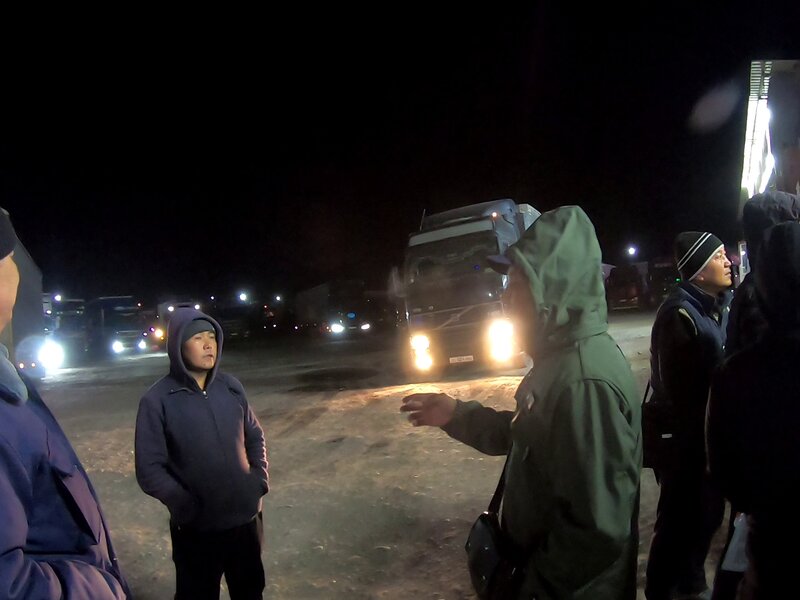
I stood there with the officer for another five minutes, waiting for the driver to come back. The officer glanced at me and said, “Tebe ne kholodno?” (“Aren’t you cold?”) I thought to myself what the Russian expression was for “Duh?” I was freezing and my whole body was shaking, having walked all the way from the Chinese side. I tried to explain to the officer that I’d had a driver and he had ditched me because I wouldn’t pay him more money. I probably wasn’t making much sense in Russian, but the officer nodded politely as though he understood. No joke, it was freezing. But when he asked me where I had been and where I was headed, I forgot all about it and gladly went over my entire itinerary. Sometimes people like to talk about themselves.
Soon the driver emerged from the building and waved me over to where he was parked. I thanked the officer and turned toward the sea of parked trucks, and he just said “Udachi tebe” (“Good luck”). The driver and I hurriedly walked to the truck to escape the fierce wind. It wasn’t parked too far away, and up close, it appeared much more massive than I had imagined. I practically climbed onto the seat and closed the door behind me against the freezing wind. The driver also hopped in after doing a quick check of the outside, and the beast awoke from its slumber with a deep engine sound that shook the ground. The truck started slowly rolling down the dirt road, with its whole body bouncing over the uneven surface. We left Irkeshtam behind, the ungraceful beginning of the ride throwing our bodies in every direction.
“Otkuda?” the driver asked curtly (“Where are you from?”) as he tried to steer the bouncing truck straight on the dirt road. I misunderstood and stuttered “Seychas ya… Osh” (“Now, I… Osh”). Having only practiced Russian with my colleagues, I still couldn’t get the hang of speaking it in real-life situations. “Kak zovut?” (“What’s your name?”) he then asked, and we managed to introduce ourselves. His name was Suiun and he was from Osh. “Tebe nuzhno dnyom nado yekhat’” (“You should come during the day”), Suiun said. “Noch’yu nichego ne vidno” (“You can’t see anything at night”). I thought to myself, “It occurred to me, too. But I had a transport problem and had made some concerned friends in China who wouldn’t let me go.” In any case, he wasn’t exaggerating. I couldn’t see anything outside the window except the pitch-black darkness. He also said that we were going to climb very high into the mountains, which were around 3,500m (11,500ft) high.
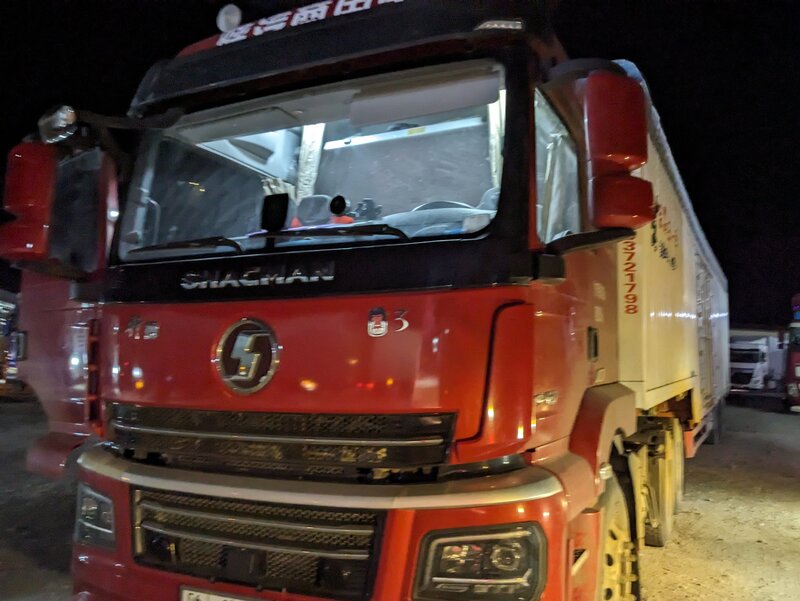
Up until this point, I actually didn’t know how far Osh even was. The only thing I knew was it looked kind of far away on a map. So I asked Suiun, “Skol’ko chasov nuzhno Osh?” (“How many hours need Osh?”) Suiun casually said, “Eto shest’ sem chasov” (“Around six or seven hours”). I couldn’t believe my ears and asked a couple of times, “Sem?” (“Seven?”) I was genuinely shocked because it was now 8:00PM. Did he really mean that we’d be driving until 2:00AM? As I tried to ask that question in disbelief, I failed to find the proper words and was mixing English. Sensing my shock, Suiun slowly explained it’d be 2:00AM or 3:00AM when we arrived, and that we needed to drive around 250km (150mi) through many mountains. I hadn’t eaten anything since lunch with Chinese friends in Ulugqat and was cold and tired. I doubted I was prepared for a seven-hour ride. But ready or not, I had to get to Osh. We drove in silence for a while.
Breaking the silence, Suiun suddenly said that I didn’t need to worry about finding accommodation in Osh, and that I could stay with his family. His offer surprised me deeply. Here I was, just a stranger who had hopped on his truck in the middle of nowhere, and he was opening up his home to me. I found myself wondering whether I could do the same thing for someone. Was I capable of extending the same helping hand? I wasn’t sure, and that made me pause and think. When I thanked him and accepted the invitation, Suiun added I could stay for as many nights as I needed while I explored Osh. Still confused by this generosity from a stranger, I told him one night would be more than enough because I would need to move on. Suiun simply said that the offer was still open in case I changed my plans.
After about an hour and a half, we were driving through a small village. It must have been Sary-Tash. Suiun said the mountains were so high around this area that very few people lived in the village. There was nothing much to see at all except for a couple of houses along the roadside. No one was around. The only reminders that someone lived there were the scarce lights from the windows. As we crossed the empty town, only the street lamps looked down at us with indifference. They just stood there motionless in the middle of the cold night, not caring where we came from or where we were going. Suddenly, a three-way intersection appeared and Suiun pointed to the road on the other side, saying “Vot, tuda Tajikistan” (“That way is Tajikistan”). I was fascinated and tried to look out, but couldn’t see much in the dark. He said that the border was closed due to a conflict. So even if I had wanted to go through Tajikistan, I wouldn’t have been able to anyway. It made me feel better about having to move on quickly.
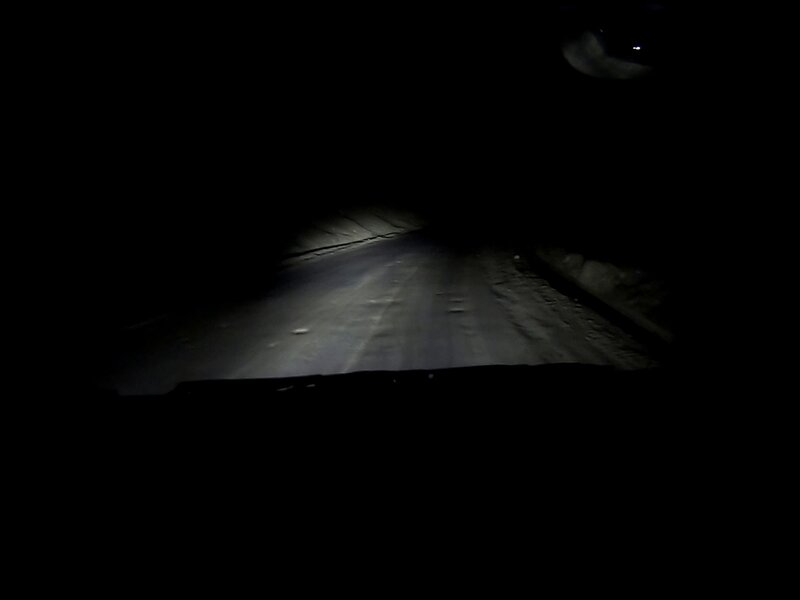
Gradually, the truck climbed the mountain with heavy grunts, pulling its heavy cargo behind. The street lamps had disappeared long ago, and the only source of light was the truck’s headlight. We could probably only see around 30m (100ft) ahead, and the rest was entirely shrouded in darkness. I wondered where we were, but couldn’t check because I wasn’t getting any signal on my phone. Noticing that I was staring at my phone, Suiun said there wouldn’t be any internet for several hours. We passed the time by talking about random things about our lives while sharing a bag of walnuts he kept next to the gear stick.
Suiun was a hard-working man who drove trucks around twelve hours every day and made the drive to China three or four times a month. He showed me a video of his relative’s wedding, and when I asked when it was, he said it had already taken place that night. He had missed it because he was driving the truck, with me. He said that his Russian was weak because he went to a Kyrgyz school, and that his wife was fluent because she went to a Russian school. But he spoke it anyway because it was widely used and he used to drive trucks in Siberia. At this point, I also talked about my plan to reach Dublin, and the fact that I was leaving Australia to move to Seattle. I added that I was in a rush because I had only seventeen days left in my trip. “Tebe nado poyekhat v Bishkek” (“You should still go to Bishkek”), Suiun said, “Osh nebol’shoy gorod” (“Osh isn’t a big city”).
Even at that time of night, we still occasionally saw other trucks on the road, carrying various cargo. “Eto ugol” (“That is ugol”), Suiun said, pointing at a truck passing us in the opposite direction toward China. It took me a while to understand what “Ugol” was. “Znayesh chto takoye ugol?” (“Do you know what ‘ugol’ is?”) Suiun asked me, and explained it was a material mined from the mountain. Then I realized that he was talking about coal. According to him, this part of the mountain produced a lot of coal and Kyrgyzstan exported it to China. We kept passing more trucks fully loaded with coal, their engines rumbling as they accelerated past us. Some other trucks were coming from China and were loaded with sedans and SUVs. Suiun said those were Chinese cars being exported to Kazakhstan and Russia. I recognized them as the same kind that I had seen on the streets in China. When I asked whether Kyrgyzstan had many Chinese cars, Suiun said they didn’t really work well here because the roads were pretty bad. He wasn’t wrong–the roads in the mountains were brutal. They were often unpaved or had very uneven surfaces with potholes everywhere. As we continued to drive the dull mountain road, the truck was rocked loudly and intensely, and our chatter gradually faded. I fell asleep.
I woke up from my light sleep when the truck stopped on the side of the road for a quick break. Next to the truck was a cliff, and Suiun was standing there, looking over the edge. Although my eyelids were heavy, I was a bit curious about the view that he was getting. So I got out of the truck and walked to the cliff. As soon as I got off, I realized how cold it actually was. It must have been well below the freezing temperature in the mountains at this time of night. Honestly, the cold made Irkeshtam feel like a tropical island. “Kholodno, da?” (“Cold, right?”) Suiun said casually as if it was nothing. He was just wearing a vest over a long-sleeve shirt. “Da, ochen!” (“Yes, very!”) I barely made a sound as I tried to speak, still half asleep and shaking uncontrollably.
But then, I looked down the cliff. There were these tiny, upside-down cones of light moving in a zigzag formation. Everything else was dark, and we were so high up in the mountains that those cones looked almost like tiny dots. In my stupor, it took me a second to realize what they were. They were headlights coming from trucks just like ours, climbing up the mountain one after another in the pitch-black darkness. Ensnared by the frigid darkness and unforgiving mountain roads, their feeble movement seemed almost inconsequential from the distance. And in their struggle toward the height, I saw a little bit of myself–I don’t know why, but that made me chuckle. They reminded me of my own battles. In my daily struggle for what I called success, was that how I must have looked? I wished those tiny lights would find the strength to reach the top. In a moment, Suiun and I hurried back to the truck to escape the freezing wind, leaving the spectacle behind.
Arms folded and head down, I slept as we rode through the mountains, only occasionally waking up to see the nothingness outside. But slowly the scenery was changing outside. At one point, lamps lit up the roadside again, and normal cars–not trucks–drove by once in a while. We must have been at least out of the middle-of-nowhere mountains. When a sudden stop of the truck woke me up at around 2:00AM, I noticed that we were at a traffic light facing empty streets of an unknown city. It was the first traffic light since the truck stop at the border many hours ago. I looked around to figure out where we were, staring at the signs written in Cyrillic script and the unkempt, empty roads. Everything was bathed in a dark orange color as the dim streetlights mixed in with the night.
“My v Oshe” (“We are in Osh”), Suiun said, noticing that I was awake. The first impression of Osh was rough, probably because it was the middle of the night and all I could see on the streets were trucks speeding through dusty roads. Soon we drove through a roundabout with a huge statue of a warrior in full armor riding a horse, and a separate statue of what looked like his pet tiger. Suiun said that the warrior was Manas, a legendary Kyrgyz hero. We then passed yet another roundabout, and Suiun pointed to the right and said, “Vot eto Dostuk. Eto granitsa s Uzbekistanom” (“Here is Dostuk. It’s the Uzbekistan border”). Remembering my story about needing to go to Uzbekistan to keep moving west, Suiun added, “Zdes’ ty mozhesh pereyti v Uzbekistan” (“Here, you will be able to cross into Uzbekistan”). I thought I’d check out the Manas statue again on my way to the border during the day.
Soon we parked the truck in a gravel field where hundreds of other trucks were already sleeping. When I’d left Kashgar the morning before, I wasn’t even sure I could cross the Irkeshtam Pass. But owing to the kindness of many strangers, I had traveled around 400km (250mi) all day and all night, across the border and through the freezing mountains, to reach Osh. I wasn’t used to such kindness from strangers and didn’t know if I should give something in return. Remembering the yuan I’d gotten for emergencies, I carefully offered 300 yuan to Suiun. “Zdes’ dlya benzin” (“Here is for the petrol”), I said, unsure how he would take the offer. He looked confused and said money wasn’t necessary. I still tried to insist, but he wouldn’t accept it.
The truck stop was on the outskirts of Osh, far from everything else. So we took a cab to Suiun’s apartment. The streets were empty and the only sound was the choir of the crickets. We quietly went up to the apartment trying not to disturb his family who must have been sleeping. A bed had already been neatly made for me in the corner of the living room, and all the furniture had been moved out of the way to make space. “Khochesh’ pokushat’?” (“Wanna eat?”) Suiun asked. I couldn’t argue with that. We heated up some soup with potatoes and meat, and broke some bread. I also pulled out my Uyghur bread that I’d crammed into my backpack while crossing Irkeshtam. It was broken into pieces but was still edible.
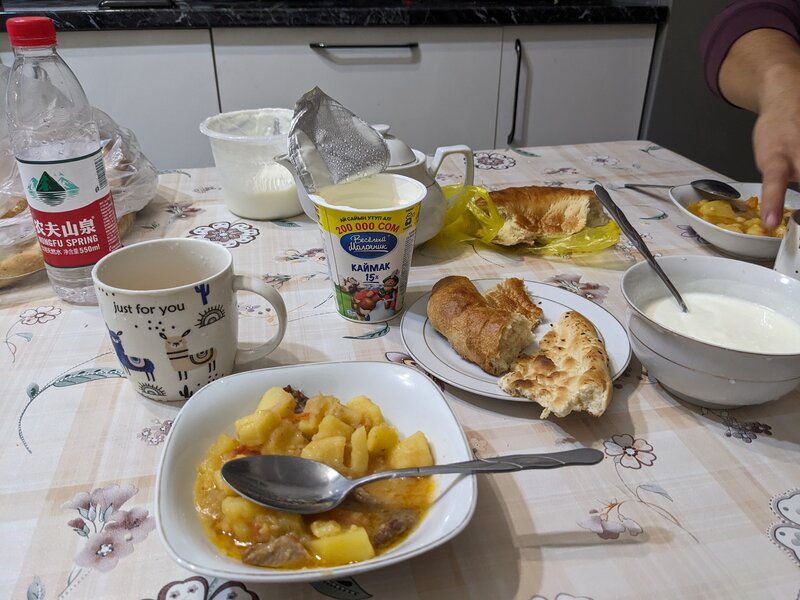
“Tebe nravitsa?” (“Do you like it?”) Suiun asked as he looked with interest at the giant bag of Uyghur bread. “Da” (“Yes”), I answered. What I really wanted to say was, “You have no idea. It’s all I’ve eaten since noon yesterday.” But I just didn’t have the energy. After having some soup and tea, I started warming up for the first time in a long while. But I couldn’t relax as I needed to think about when and how to get to Uzbekistan that day, and how to make the best of the little time I had in Osh. After we sat around a bit, Suiun did the dishes, refusing my offer to help. He told me to let him know if I needed anything and retired to the bedroom.
I went into the living room and started planning. Where I would go once reaching Uzbekistan was clear. I needed to get to Tashkent to meet the ethnic Koreans who lived near the city. But Tashkent wasn’t so close. On the map, the distance to Tashkent appeared much greater than what Suiun and I had traveled that night. The sheer distance intimidated me, but I had no choice but to head for Tashkent when the sun came up. I needed to move west, and didn’t have much time. Besides, in spite of the scary distance, it didn’t sound all that impossible to get to Tashkent. Reaching Osh had filled me with a naive optimism once again. If I could find direct transport from the border, I could probably reach Tashkent in less than eight hours which was about how long it took me to get from Irkeshtam to Osh. I didn’t know how to get transport, but I was too tired to think further. Here was a rough plan: sleep, get up early to explore Osh, and leave for Uzbekistan around noon.
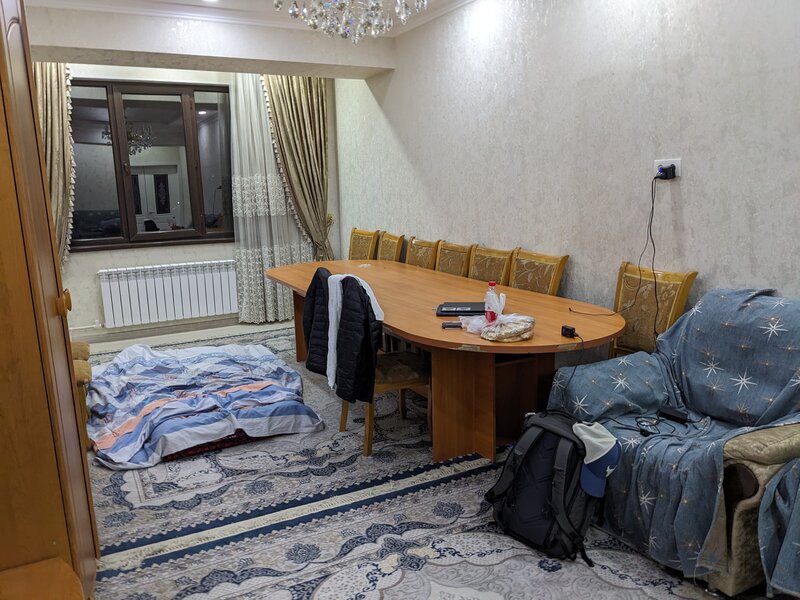
It was almost four o’clock. I thought I’d fall asleep as soon as my head hit the pillow, but I couldn’t. I kept thinking about everything that I’d experienced in the past twenty hours since leaving Kashgar. Mostly I kept thinking about the kindness of strangers. Can I do the same for others? No matter how many times I asked myself, I couldn’t get a straight answer. The unconditional help from everyone was more confusing than moving or touching, probably because I didn’t know how to give it. I kept thinking about the question I’d formed a couple of days ago in Urumqi: “People are kind. Can I be just as kind to others?” The question kept repeating in my head until I fell asleep without realizing.