I woke up late for the first time since Central Asia, but hardly had any rest because of loud snoring that lasted the whole night. I doubt anyone in the dorm had much sleep, either. At least, I didn’t roll off my tall and narrow bunk bed that had no guardrails, so that was something. When I headed to the rooftop to have some breakfast, seagulls were circling the spotless autumn sky above, gliding through the cold and fresh morning air. Past the disorganized, untidy rooftops and chimneys of nearby buildings, the strait separating the European and the Asian sides was barely visible. The dark blue water was as tranquil as the clear sky above, and container ships were floating idly. The serenity felt so foreign after battling my way here. For once, I took my mind off the road ahead and soaked in the strange sensation of peace.
I lingered on the rooftop a bit longer before checking out of the hostel. The shower was probably the last one for a while. Until I reached the other side of Europe, I would most likely sleep on trains and in stations over the next few days. But, for now, I was all freshened up. The sky was so crisp and perfectly blue, and my steps were brisk and full of purpose as I headed out. The first thing I did was find a luggage storage to drop off the backpack, because I didn’t want to get drenched in sweat carrying it around the city all day. The hostel owner told me I could stash my backpack under the furniture in the lobby, but I didn’t really want to take the chance. The luggage storage I found was near Sirkeci station. On my way there, I stopped by the ticket office to double-check exactly where and when the train to Bulgaria was departing in the evening. The uniformed attendant glanced quickly at his screen and told me that the train was departing as scheduled that night, and that I needed to board it at Halkali, a station about one hour away by subway.
Stepping away from the ticket office with a renewed assurance of the coming day’s plan, I randomly drifted into an old part of the station with its charming and antiquated walls and mosaic windows. The place seemed old–probably built long before I was born, or anyone else around, for that matter. I stood in the waiting room, trying to imagine all the passengers who had stepped through the very place. Some of them must have been on their way to Europe, just as I was. While I was lost in this thought, I met a local man and his son who were also walking in the area. “You are from where?” they asked, and I went with, “I’m from Korea.” We shook hands and the father said, “Our countries are friends.” The gesture of friendship from a total stranger made me feel at home.
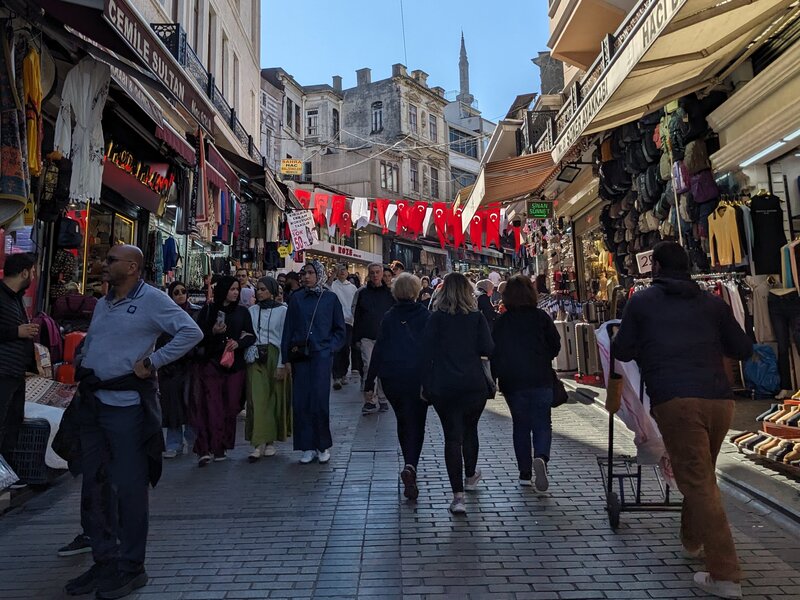
Leaving the station, I walked along the busy and winding streets toward the Grand Bazaar. Although I knew little of its history, a large historic marketplace in the middle of Istanbul, I thought, must have something to do with the Silk Road trade. Having followed that road all the way here, I kind of wanted to leave my own footprint in that place and see what the merchants and travelers had seen for centuries as they traversed that vast East-West conduit. It was almost noon, and the serpentine, hilly streets of historic Istanbul were overflowing with crowds wandering through the brisk weather. As I got closer to the bazaar, the crowd thickened and the street commerce became more and more lively. Roadside stores were selling everything from carpets to jewelry. Then I found a bazaar entrance, leading into what appeared to be an old structure. Unlike the outward appearance, the inside of the bazaar was generally modern and well organized. In many ways, it felt like a neighborhood shopping mall with a bit of a foreign twist. I’d hoped to see some sort of sign that I had finally made it to the terminus of the great Silk Road. But the stylish coffee shops and luxurious storefronts gave no hint of that ancient history. It wasn’t until later that I found out the bazaar was built well after the traditional Silk Road’s heyday.
The bazaar was so enormous that, walking out the other end, I didn’t even recognize where I was. There was a large, mostly empty square with some university buildings and mosques. A big Turkish flag was flying high in a cloudless blue sky in which a lonely aircraft was drawing a fragile vapor trail as it flew across. The plane was so high up in the air that it appeared only as a dot. I could barely make out the glare on it as the bright afternoon sun reflected off its tiny figure. I wondered where it was going and how everything looked from above. The dot disappeared behind the Turkish flag dancing in the wind, and eventually faded into the distant side of the sky.
Leaving the dissolving contrails of the aircraft behind, I walked into narrow and bustling streets now echoing with the call to prayer. The road supposedly led to a large mosque on top of a nearby hill. On the way to the top, a local kid standing near a souvenir shop tried to greet me in Mandarin, “Ni hao,” hoping to usher me into his shop. If there are certain obligations that a Korean person must fulfill in life, surely one is to clarify their nationality when greeted in Mandarin. I dutifully observed this unwritten rule and told him with a smile that I was from Korea. With a chuckle, the kid bumped fists with me and declared, “We are brothers.”
On the way to the mosque, far from all the fancy lounges and rooftop bars, there was a small, unassuming restaurant packed with students from the nearby university and other locals. I was sort of hungry but didn’t know how or what to order, since the menu on the wall wasn’t in English and no one showed me to the table. I just followed other customers by going up to the kitchen area and pointing at the food I wanted. I didn’t even know how much it cost because there were no price tags next to the food. So I just picked some rice, baked beans, and beef patties. After my clumsy attempt at ordering, someone from the kitchen led me to a corner table in a busy area and brought out the dishes. The food was simple but, for some reason, it really hit the spot. Little did I know that it was the last meal I’d have for the next forty-eight hours.
I eventually arrived at the mosque after lunch. From there, I could see the northern part of Istanbul across the waterway, as well as the Asian side on the other side of the strait. It dawned on me that I had never really explored the Asian side, and that it’d be cool to see the European side from there. I walked down the hill and headed back to the busy Sirkeci station to get on the subway across the strait.
The Asian side wasn’t far–only a single station away. The waterfront bustled with activity as people patiently watched their fishing lines while facing heavy wind blowing from the European side. I leaned over the blue water to get a better look at the other side. Europe. I needed to get to the other side of it in four days. Doubt, excitement, fear, curiosity. As a hodgepodge of emotion filled my mind, the restless water kept lapping against the bank below. There was a local youth who was also staring into the other side of the strait, and we struck up a conversation. “Must be cool to live in such a beautiful city,” I laid it on a little thick, trying to say something nice. The guy smiled and said, “Of course, but it has problems.” We then talked about the rising prices and everyday struggles. Thousands of miles away from home, the problems that people faced were remarkably familiar.
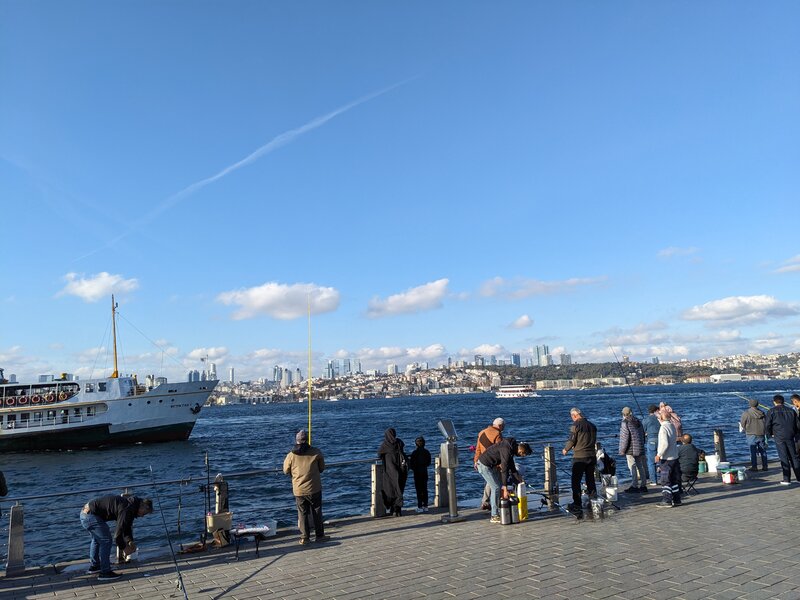
I walked down the lazy shoreline, passing by the fishing lines, ships of various kinds, and people just sitting by the bank. Everything looked so peaceful. Across the water, the sun was on the low side of the sky and looked like it was on its way down. The setting sun and the glittering sea hinted that my final hours in Istanbul were rapidly approaching. This sudden realization of the time’s passage interrupted my relaxed walk, reminding me to head back and go to Halkali station. It was already around five o’clock, meaning I had three hours until the train would depart. Three hours wasn’t as long as it sounded. Halkali was around an hour away and I still needed to pick up my backpack and probably would want to have some food. Besides, the subway was probably going to be packed during the rush hour and maybe I couldn’t just waltz in. Feeling a little tense, I walked back to the station and sat down for a bit to take in the last glimpse of Istanbul before I left. The call to prayer started playing from a large mosque nearby. The water continued to ripple and glare as the evening approached and fishing lines were thrown.
By the time I got to the European side and picked up my backpack, it was almost six o’clock. Realizing there wasn’t enough time to stop for dinner, I hurried toward Sirkeci to catch a subway to Halkali. As I slowly pushed through the narrow sidewalks crowded with pedestrians and traffic lights, the fifteen-minute walk to the station felt like an hour. Hagia Sophia and the Blue Mosque were slightly glowing in the golden color of the evening sun. With my every anxious step, the colors seemed to grow even more intense. I was too focused on walking to stop and take another good look at them. Still, I had time to stop for an ice cream from a street vendor doing the Turkish ice cream trick. The trick was that the sellers playfully made it look as though they were giving you the ice cream while never quite doing so. I had seen the trick yesterday and wanted to have it done to me, although 100 lira ($4.30) a pop was a bit painful. As my luck would have it, my ice cream man was kind of a novice and his tricks were clumsy at best–I even got some ice cream on my fingers. But at least it was pretty tasty. I walked briskly through the crowd with the giant backpack, licking a vanilla ice cream cone held in one hand and checking a map with the other.
The path to Sirkeci wasn’t smooth. The map led me to a small station entrance with a slow elevator and a long line for getting on it. When it became obvious the line wasn’t going to budge, I walked a few more blocks to the main entrance. The main entrance didn’t have the elevator problem, but I couldn’t get through the turnstiles because my metro card had a low balance. It took a couple of nervous retries to get a machine to accept my credit card and let me top up. All this drama ate up some time, but I managed to make a run for the next subway to Halkali. As I expected, all the subway cars were full of rush hour passengers and there was hardly any room. With some luck, I was able to squeeze myself and the backpack into the middle of a car.
The subway slowly made its way to Halkali. At first, I grew a little more restless at each subway stop, worrying I might get there too late. But I relaxed after finding out that the train was going to arrive there a few minutes past 7:00PM. That left plenty of time to make the connection. After running through the underground of Istanbul for a while, the train emerged into the open air and revealed through its windows the dark blue sky being swallowed by the falling dusk. What little remained of the daylight was helplessly painting the far edge of the sky in a bright orange for one last time. The street lamps were already dotting the vague and unfamiliar landscape obscured by trees and the darkness. The scenery was beautiful but soon there was nothing to see except the pitch-black night and the blurred reflection in the windows.
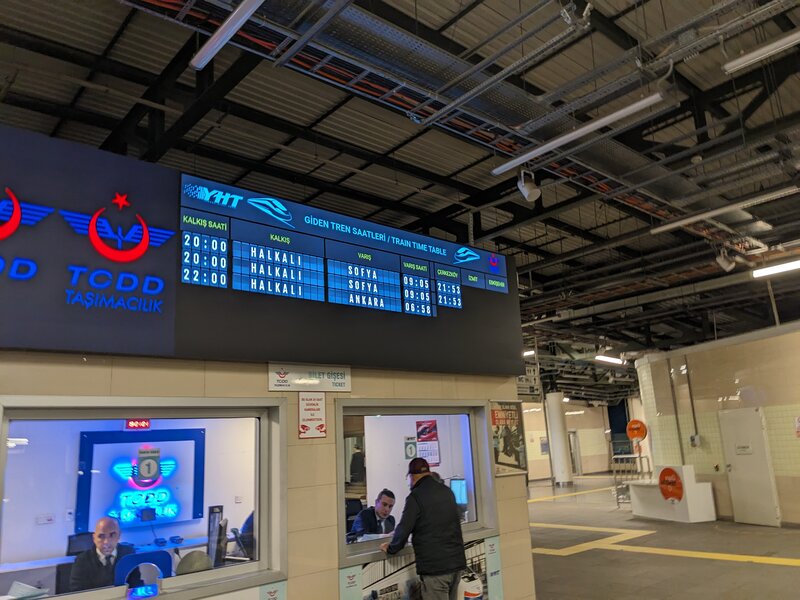
Without much to do and squeezed in the middle of the subway, I tried to reverse-engineer the sounds of the mysterious Turkish alphabet while listening to the announcements and looking at the station maps. I didn’t get too far and we finally approached Halkali. There were still plenty of passengers, but Halkali was the last stop of the line and everyone went their own way once we arrived. All the platforms were empty and there was barely anyone around in the entire station. Hoping I was at the right place, I took the stairs from the platform and drifted into the concourse above. And there I could see a ticket office with a display showing a 20:00 departure for SOFYA. The clerk at the ticket office told me that there was no platform for the train yet, and that I would just have to wait around.
I’d already given up on the idea of dinner because departure was in less than one hour, and there were no open restaurants near the station. But I still needed some snacks and water for the train ride. The timing was a bit awkward because the nearest open supermarket was fifteen minutes away on foot, but I still took the chance and headed out. Every traffic light seemed to last a little too long and left me staring at the clock. The night was chilly, which I hadn’t noticed when I was walking around last night. I bought some brownies and a bottle of water, and rushed back to the station with my cold breath growing unsteady with each step. What stole my breath was partly the cold breeze, partly my concern about missing the train, and partly a growing realization that the final sprint toward Dublin was beginning. What if I miss one of the various connections at Dimitrovgrad, Gorna, Ruse, or Bucharest? And even if I could make the connections, where would I even go next and would I have the strength to continue? Thoughts raced in my head.
Slightly out of breath, I marched back into the concourse to find the platform still hadn’t been announced. But a small group of backpackers were already hanging around in the area. “Are you guys waiting for the Sofia train?” I asked one of them. “Yeah, but we don’t know the platform,” a guy replied with an American accent. I dropped my backpack and the bag of supplies on the ground and stood around. Soon, there was a loud announcement in Turkish which I couldn’t understand, and a small line began to form toward a platform as people appeared out of nowhere. With my fingers still sticky from the clumsy ice cream trick, I carefully took out the train ticket and headed to the platform. Board that night train and go. That was the only way to deal with all the unanswered questions.