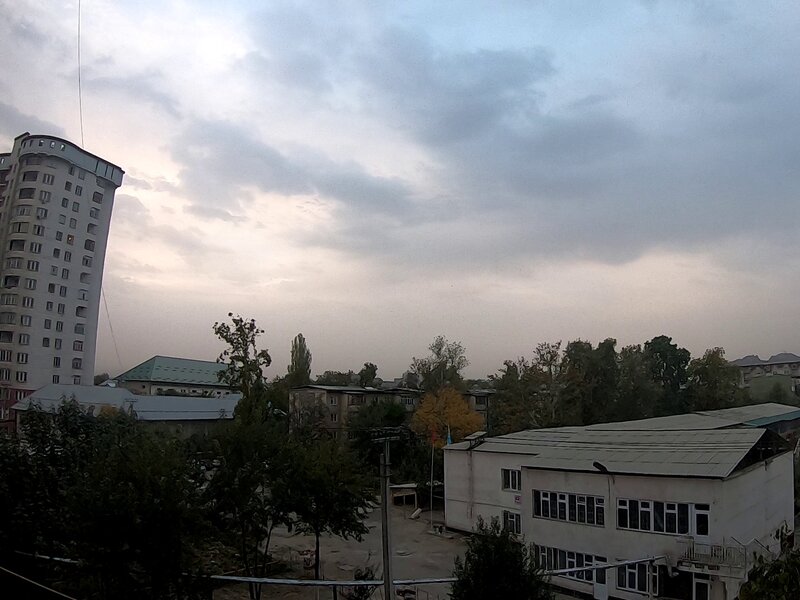
The sun rose over Osh and the cruel autumn night disappeared without a trace. I sprang up and looked outside the living room window, trying to see the real Osh that last night’s darkness had been hiding. Osh under the gray morning sky looked grim. There were some decrepit buildings with yards strewn with random scraps of metal and panes of glass, and old low-rise residential buildings. I liked this rough, unpolished impression of the strange city. I’d had only three hours of sleep, but I didn’t have the luxury of being tired. There were around 400km (250mi) to cover to Tashkent. If I wanted to make it there by evening, I had to cross the border by noon at the latest, assuming everything would go smoothly. This left me with only a couple of hours to explore Osh. I was eager to begin the day.
As I started folding the mattress and packing up my stuff, one of Suiun’s sons came into the living room and greeted me. He introduced himself as Elhan and invited me to have breakfast in the kitchen. Elhan brought out a bowl of hot stew, cheese, and bread along with a cup of tea. I also opened up the good old bag of Uyghur bread from James. There was still a good amount of bread left in the bag even though I had been nibbling on it for quite some time. It seemed to possess a magical quality of somehow never running out. A younger son of Suiun was watching cartoons and noticed the bread. I greeted him and asked, “Nravitsa?” (“Do you like it?”) I thought maybe I’d share some with him. But he didn’t say anything and simply kept watching his cartoon.
The morning was getting in motion in the household. Suiun was up and saw that I had already met Elhan. He said Elhan would show me around Osh today since it was Saturday and school was out. Suiun’s wife was also up and getting ready to head out to work. I thanked her for the hospitality, and she simply said “Ne za shto” (“My pleasure”). Suiun, Elhan, and I headed out to the quiet morning streets of Osh. As I dragged my heavy backpack out with me, Suiun said I could leave it at the house if I wished. But I explained to him I’d be heading to the Uzbekistan border directly.
As we walked down the morning streets, things were slowly waking up. The city wasn’t as grim or desolate as it had looked from the window. There were people around and shops were opening up one by one. It was just a city, and people lived in it. Suiun went into a shop, got some Kyrgyz som out of an ATM, and handed it to Elhan to show me around town. That made me feel awkward. Not only had he given me a ride, a bed, and food, but now he was also spending money to ensure I would get around town. I wanted to say it wasn’t necessary but didn’t want to be out of line. I just felt indebted and grateful. After a brief chat with Elhan, Suiun went off to work. “Udachi” (“Good luck”), he said as he walked off. He told me to drop him a line next time I was in Kyrgyzstan. What a legend. He had driven all night and was going back to work on a Saturday morning. I thanked him for rescuing me and wished him all the best.
Elhan and I started walking down the rough sidewalk. He was a high school student who spoke excellent English. “Where would you like to visit in Osh?” Elhan asked me in English. “How about the Lenin statue? I heard there was a big one,” I replied. Elhan said he knew where it was and that it was going to be a bit of a walk. So we started walking down the main road to the southern part of the city where the statue was supposed to be. Relics of the Soviet Union had always fascinated me because they provided a glimpse into a closed chapter of history. They allowed me to pierce the veil of time and space to peek into the failed machinery that had long disappeared into the backstage of history. When I had noticed this unusual statue on a map last night, I knew that I had to check it out. Little did I know that I’d actually find another large Lenin statue in Seattle when I eventually moved there, but that’s another story.
The streets of Osh were rough but had a certain unrefined charm. There were casual reminders of the nation’s Soviet past everywhere. Elhan and I randomly came across Mishka the bear from the 1980 Moscow Olympics smiling at us from the side of a random building. He was painted on a typical five-story apartment block built by the Soviets. Mishka must have been standing there for over forty years, looking down, with his innocent smile, at the same rough street of this small town. As regimes rose and fell, ideologies changed, and people lived and died, this mural remained. It was one of the only constants that connected today with the past that now felt so distant, casually standing on the side of an unassuming street.
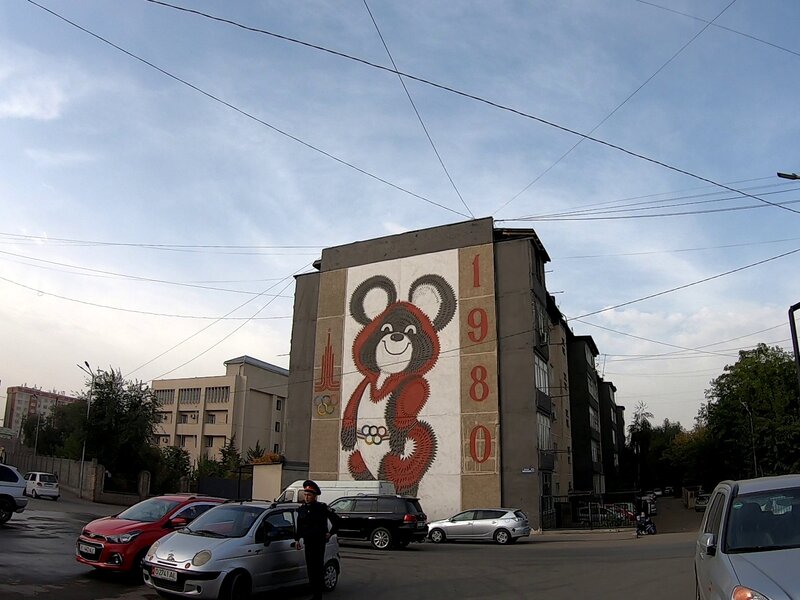
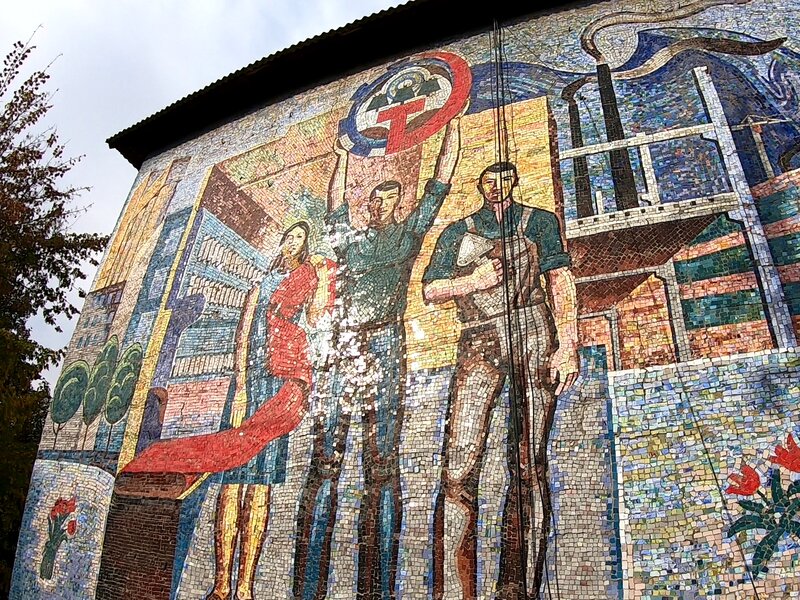
I stopped and gazed at the mural like it was the ceiling of the Sistine Chapel. A policeman walking nearby gave me the eye, as if to say, “What’s he looking at this thing for?” Sensing my unusual fascination with Mishka, Elhan tried to explain by saying, “There are many paintings like this on old buildings.” He was right. As we continued, we kept stumbling upon murals and mosaics on the walls of five-story Soviet apartments. The mosaics depicting the imagined utopia were now slowly fading on the sides of weathered buildings. The decaying reminders of paradise that never came added to the melancholy of the slightly run-down streets of Osh under the cloudy autumn sky.
Soon, we crossed a tall pedestrian bridge at a busy intersection. All the streets were getting busy with people and cars going about their business. On the bridge, I could see a tall rocky mountain not far from the city. Elhan explained the mountain was called Sulaiman-Too and we would go there to check it out later. I wasn’t sure if I had time, but Elhan said I had to at least take a look since I was in Osh. While we were on that subject, Elhan suddenly asked, “Most tourists don’t come here to Osh. Why did you come here?” I thought about that question a bit, and realized I actually had no idea. Osh was just on my way, and I happened to stumble on it. “So you don’t get many tourists here?” I asked back. “Yes,” Elhan replied, “most people visit Bishkek or Lake Issyk-Kul in the north.” Sure, those places sounded interesting, but I was happy I’d wound up here in Osh.
We arrived at the Lenin statue after an hour. The statue was perched on a pedestal that was even bigger than the statue itself. Its gaze was fixed on some place far away, beyond the town square with an enormous Kyrgyz flag. The Soviet Union had fallen long ago, but this small remnant of its past still stood tall in this corner of the world. It stood to show the vanity of grand plans and the complicated history that this land had been through. I looked up at the statue for some time, while Elhan stood around awkwardly, not knowing what to make of my unusual interest in everyday objects like Mishka the bear, the fading mosaics, and now this monument.
When I was finally done, Elhan said, “Now let’s go to Sulaiman-Too.” I looked at my watch and said there was no time, because I wanted to be at Dostuk by noon to cross into Uzbekistan. I had around an hour left. But Elhan insisted we check out the place because Sulaiman-Too was on the way and was an important place in Osh. I couldn’t say no. We headed to the nearest bus stop and waited for a marshrutka that could take us there. One arrived in no time, but it was quite packed. After being a major inconvenience to all the passengers as I shoved my backpack into the overcrowded marshrutka, I was on my way to Sulaiman-Too with Elhan. No matter how hard I tried, he wouldn’t let me pay for the fare.
Sulaiman-Too was a gargantuan rock formation jutting out of nowhere at the edge of town. Elhan said he’d come here a couple of times in his life, as a school activity or on a family outing. The mountain sounded like a special place that, if you lived in Osh, you were bound to visit once in a while. There was supposed to be a museum in the middle of the mountain, so we started walking up the hill. The short climb was scenic and there were many other local residents strolling and enjoying their weekend morning.
When we reached the shoulder of the mountain, we could get a great view of the entire city and what lay beyond. Osh was bathing lazily in the gentle sun now shining through the light clouds. The city looked peaceful and the rough impression at the truck stop last night was long gone. In the distance, through thick gray haze, I could make out massive mountain ranges that Suiun and I must have driven through the night before. That was Osh and its surrounding area. As I stood staring at Osh, it stared right back at me. Thanks to Elhan, from the slopes of the sacred Sulaiman-Too, I discovered Osh and it, too, discovered me. After that moment, I was no longer a stranger to the city.
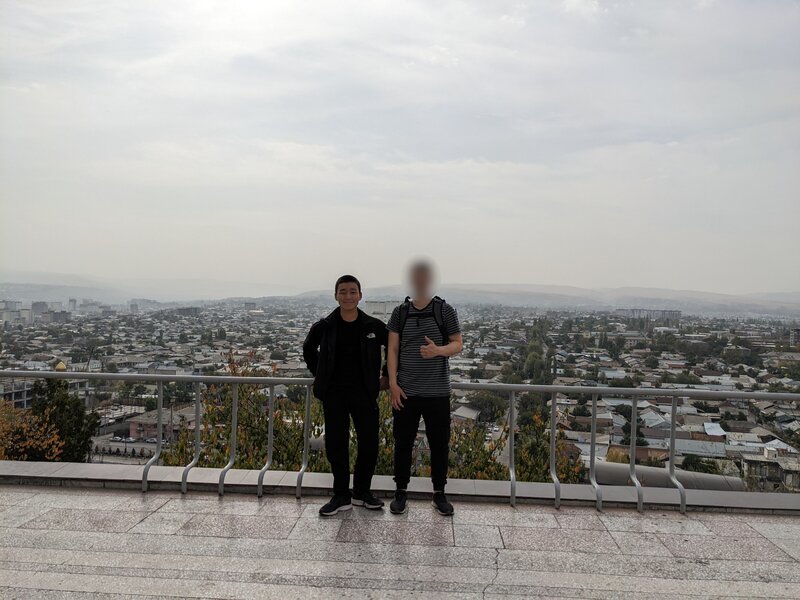
I later learned that Sulaiman-Too was considered an important landmark for those who traveled the Silk Road because it was easily seen from a distance. After all, it was an enormous rock with a unique shape. Just like I watched the rugged, faraway mountain ranges from Sulaiman-Too, the travelers before my time would have surveyed Sulaiman-Too from those distant mountains, setting their course toward it, toward Osh. I imagined a weary caravan, guided by the sight of Sulaiman-Too, pulling into Osh and looking for a place to lodge. And that thought put a smile on my face. I started this trip in the vague hope of tracing the footsteps of those who crossed these imaginary roads of mine long before I did, and it turned out I actually had. I’d seen what they once saw and had felt what they once felt.
The encounter at Sulaiman-Too made me want to stay in Osh a bit longer. It just didn’t feel right to take off after all that. It was already past noon, but I changed my mind about going straight to the Uzbekistan border. Every minute I stayed in Osh was pushing my arrival in Tashkent to later in the night, but that was fine. Sometimes, there are moments when we need to throw away our plans and do what feels right.
“Can we go to the bazaar?” I asked Elhan, remembering a huge market on the map in the northern part of the city. “Yes, it will be open,” he replied, and we caught a bus toward the north. Osh had now shaken off its lazy Saturday vibes and the streets were packed. I couldn’t help but wonder where all these people had suddenly come from. The bus crawled through the heavy traffic across a large bridge and eventually dropped us near the bazaar. Trying unsuccessfully not to bump people and things with my oversized backpack, I followed Elhan into the crowd and the narrow, winding streets, as Sulaiman-Too looked down from afar.
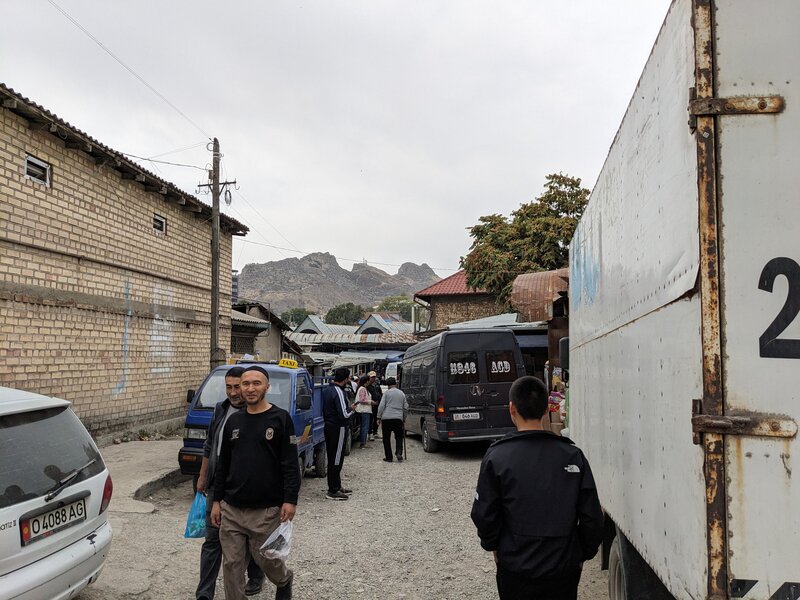
The bazaar had everything from household goods to foodstuffs. I bought a bag of snacks for the road and was barely able to fend off Elhan, who insisted on paying for it. It was nearly two o’clock, and I could no longer put off heading to Dostuk. Elhan told me there was a marshrutka leaving for the border from a nearby bus stop, and we made our way there. We passed many mosques along the road and somehow the conversation shifted to religion. “Here,” Elhan said, “most of the population is Muslim.” I was curious whether Elhan was also Muslim but wasn’t sure how to ask that. After thinking through the question for a while, what I ended up blurting out was, “Do you consider yourself a Muslim, too?” Elhan laughed and said, “That is a rather complicated question.” And he continued, “But yes, I am a Muslim. My family is also Muslim.” Silly backpacker that I was, I actually hadn’t realized I was in a Muslim-majority country, as though all those mosques and religious attire hadn’t been clues enough.
Other things that we saw a lot of on our way were street vendors selling local beverages. “Wow, is that kvass?” I exclaimed, having always wanted to try a cup of kvass in a former Soviet Union country. Elhan said those weren’t kvass and led us into a supermarket to help me find a bottle. As much as I wanted to try one, I just couldn’t impose further after he took me around town for the entire morning. I hastily got us out of the supermarket before Elhan could buy me a bottle.
We finally got to a bus stop and started waiting for a marshrutka toward Dostuk. My eye fixed on the busy oncoming traffic, I patiently scanned for my marshrutka’s number or the Cyrillic writing “Dostuk” on the side. Suddenly, Elhan waved me over to a babushka near the bus stop who was selling a local beverage out of a huge plastic drum. “This isn’t kvass, but it is close,” said Elhan, as he ordered one cup for me. I tried to tell him it wasn’t necessary, but he just replied, “I must buy you a gift since you are my guest. Take it as a gift from me.” I was worried about experimenting with an unfamiliar drink before embarking on a multi-hour trip across the border but couldn’t pass up the intriguing local drink. The writing on the drum read “Chalap” in Cyrillic, and the babushka filled a plastic cup from the faucet and handed it over to me. She chuckled as I stared into the cup and pumped myself up for the unknown drink, and Elhan said something in Kyrgyz to the babushka, as if to explain my odd behavior. The drink was sour and unlike anything I’d tried. We thanked the babushka and returned to the bus stop.
As we hurried back so as not to miss the marshrutka, Elhan started getting busy phoning somebody. He disappeared somewhere for a bit, saying that he would just be a minute. Many marshrutkas passed by, but mine never came. The time was rapidly approaching 3:00PM, and I was feeling anxious at the thought of the 400km (250mi) trip that hadn’t even begun yet. What was worse was that I didn’t know where Elhan was. Even if a marshrutka arrived, I wasn’t going to take off without saying a proper goodbye. In a few minutes, Elhan came back and asked me to follow him. Not far from the bus stop, his older brother had arrived out of nowhere with his car.
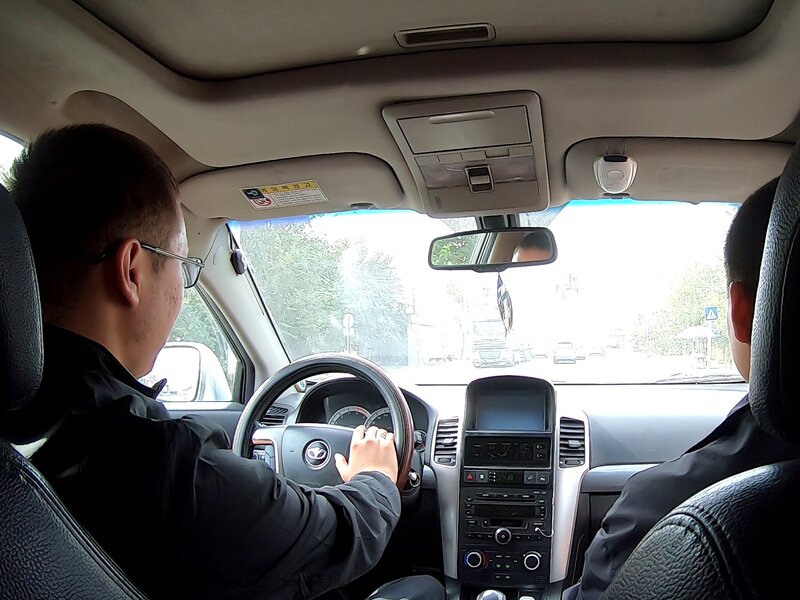
We introduced ourselves to each other, and the brother said he was going to drive me to Dostuk. We all hopped in the car and hit the road. “A kak tebe Osh?” (“So, how do you find Osh?”) the brother looked in the rearview mirror and asked me as he adeptly navigated the busy traffic. I just said, “Normal’no, krasivyy gorod” (“It is fine. A beautiful city”). We continued with the small talk, and the brother asked me what my plans were. When I told him I was going to Tashkent, the brother said we should probably stop and get something to eat because I had a long road ahead. We parked the car and started walking into a fancy shashlik restaurant. I insisted that lunch wasn’t necessary, and that just driving me to the border was a massive help already. The brother insisted back, saying that I was his guest and there was really no problem. He offered to get a takeout for the road if I didn’t have time. I was actually kind of hungry, but I didn’t have the heart to accept the offer and just said I was fine. I did have to use the restroom in the restaurant, though, because my stomach wasn’t agreeing with Chalap.
On the way to Dostuk, the familiar monument of the horse-riding warrior came into view. “Vot, Manas” (“There’s Manas”), the brother pointed to the monument and said. It was the Manas monument that Suiun and I drove past the night before. It had welcomed me as I arrived in Osh, and was bidding farewell as I was leaving.
As we got closer to the border, the brothers were trying to make sure I could safely travel to Tashkent. The brother asked, “Tam tebya kto-to zhdet?” (“Is someone waiting for you there?”) I told him, “Odin, tol’ko ya” (“One, just me”). “Tol’ko odin… Nikogo netu, da?” (“Just one… So there is no one, right?”) he replied, showing signs of concern. He asked how I was going to get to Tashkent. As usual, I had no idea. So I just replied that I would use Yandex Go. “Yandex Go tebya zhdet na granitsa, da?” (“So Yandex Go is waiting for you at the border?”) the brother asked. When I told him I hadn’t actually booked anything, he said Yandex Go probably wouldn’t work for such a long distance. The brothers, concerned, discussed my situation as I sat there clueless.
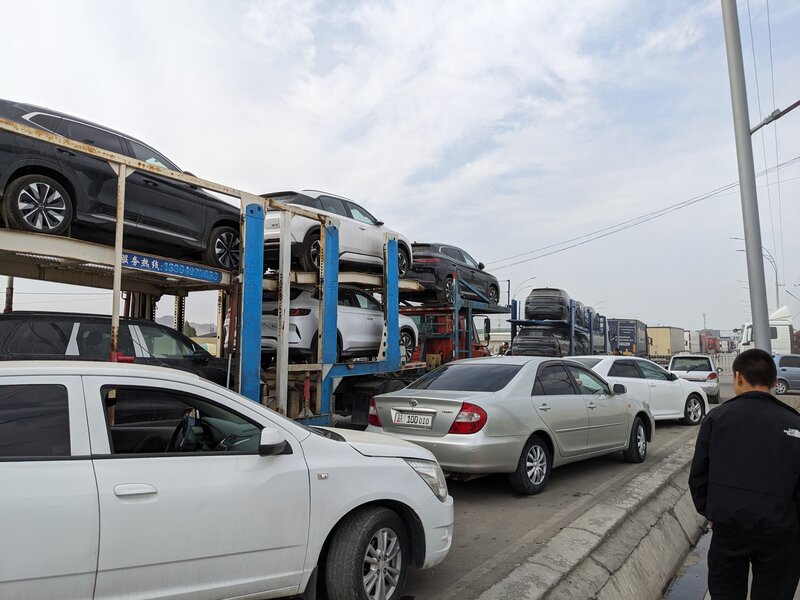
The traffic was coming to a halt at the Kyrgyz-Uzbek border. The road leading there was bleak. It was surrounded by empty containers on both sides, and a long line of trucks occupied much of the space ahead with no end in sight. The low growl of the truck engines filled the air, along with dust and fumes as the vehicles slowly crawled forward with their heavy cargo. Many of the trucks were carrying Chinese cars into Uzbekistan, and those shiny cars looked out of place in the rough surroundings. Elhan and his brother went over to some currency exchange places that had popped up on the side of the road. They asked around to get some more information about taxis to Tashkent but couldn’t get much clarity. But they told me a taxi would probably cost no more than 250,000 Uzbek sum ($20) and suggested that I try to negotiate.
We walked together alongside the enormous queue of trucks toward the border. Eventually, there was a building with huge, red Cyrillic letters that spelled “Dostuk.” There was a long pedestrian pathway surrounded by metal fencing, and uniformed soldiers were guarding the entrance. I shook hands with the brothers and said goodbye. “Udachi” (“Good luck”), they said and told me to drop them a line when I came back. I approached the metal fence, waved to the brothers, and handed my passport to the soldier. The soldier waved me through, and I started walking the long and narrow path toward the border control. Halfway through, I looked back at the brothers. But they had already faded away behind the endless parade of trucks, dust, haze, and the tall metal fence that separated us.