The train was noticeably emptier by the time it crossed into Germany and made a stop in Munich. Most passengers had already gotten off and gone their separate ways. Only the bright white light from the ceiling filled the empty spaces left behind. I kept squirming from discomfort, almost dozing off but never quite falling asleep. Outside the train window was mostly nothing but darkness. All I could see with my half-awake, dry eyes were blurry reflections of the empty seats and tables. The train made a few more stops at empty, cold platforms until finally arriving in Stuttgart. The temperature in Stuttgart at five in the morning was unforgiving, making me regret once again not buying a proper jacket when I had a chance. My original plan was to spend some time in the station until sunrise. But there was nowhere to take shelter because the station was open-air. I’d been calculating and optimizing my moves for the past few days. But what was the equation for the cold, open-air station at five in the morning?
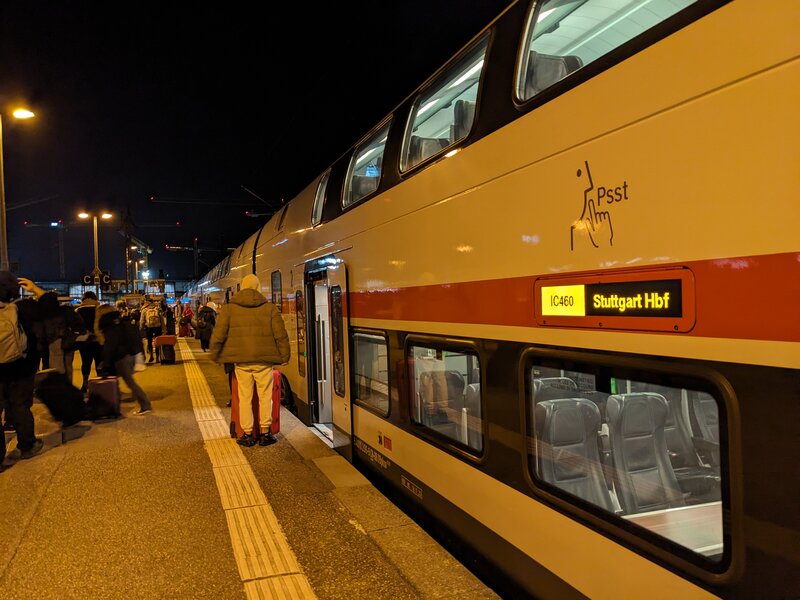
Not wanting to spend the next few hours out in the cold, I started thinking about alternatives. Now that I had gotten as far as Southern Germany, getting to London was a lot simpler. I just needed to get to the nearest city that had a Eurostar and hop on it to cross the Channel. In my case, that city was Paris, since I’d already booked a Eurostar ticket from there. If there was a way to get to Paris earlier, I could even catch an earlier train and get to London by the afternoon. This plan was doable because changing the boarding time was allowed for Eurostar. Who knows, maybe I could even get to Dublin on the same day. The day hadn’t even begun yet, and the possibilities were endless. With this idea, the first thing I did wasn’t look for shelter from the cold, but rush to the ticket vending machine. I needed to find a train to Paris that would leave earlier than mine at 3:00PM.
The ticket machine showed two trains that were leaving for Paris before mine. It showed that one of them was sold out, but the other one leaving at around 7:00AM had seats. This unexpected discovery raised my hopes. It was surprising to see because that option had never appeared in my searches before. That train was perfect for the following plan: I’d arrive in Paris by 10:00AM and get on a Eurostar train to London at 11:30AM, arriving there by 1:00PM. That wasn’t all. I could even leave London by 4:00PM and arrive in Dublin by 1:30AM the next morning, on October 27. That would have been a huge win because I wouldn’t have to look for a hostel in London at an eye-watering price. I could even leave Dublin that same day and still land in Seattle on October 27. I probably wouldn’t have done that since I wanted to check out Dublin, but that itinerary would mean beating the timeframe by one full day.
One problem pulled my wild imagination back down to earth. Whenever I tried to purchase the ticket, the machine wouldn’t process the order and instead gave some error message I couldn’t understand. I figured the train was most likely sold out, which explained why I hadn’t seen that train earlier when I was looking for options. But hope is a funny thing. I continued to poke around on the off chance that even one ticket was somehow available. Realizing there was a small room near the concourse with an information desk, I walked in there and asked the staff whether I could still purchase a ticket for the Paris train at 7:00AM. The staff said that she didn’t have access to the reservation system and that I’d have to go to the ticket office, which was in a nearby building. Of course, it wasn’t open yet, but I found a little waiting room with some wooden benches on the way there. It wasn’t anything fancy, but the temperature was at least bearable. I camped out there for a bit until the ticket office opened.
The wait was for nothing. As I expected, the ticket office had nothing for me because all the other trains to Paris had indeed been sold out. I went back to the wooden benches and waited it out more, since everything was still dark and cold. The waiting area was mostly empty except for a few travelers who came and went, and a handful of homeless people sleeping on the floor beside empty bottles. A small television on the wall showed the upcoming departures. I watched the 7:00AM Paris-bound train leave on that screen. I should have been on it. But missing that train gave some needed closure to finalize the upcoming steps. Today was October 26 and I’d be in London late that evening. So I booked the train and ferry tickets from London to Dublin for the next day, October 27. And I finally booked a plane ticket to Seattle on October 28–I’d leave Dublin at around 4:30PM and land in Seattle at 7:00PM local time. The puzzle was coming together.
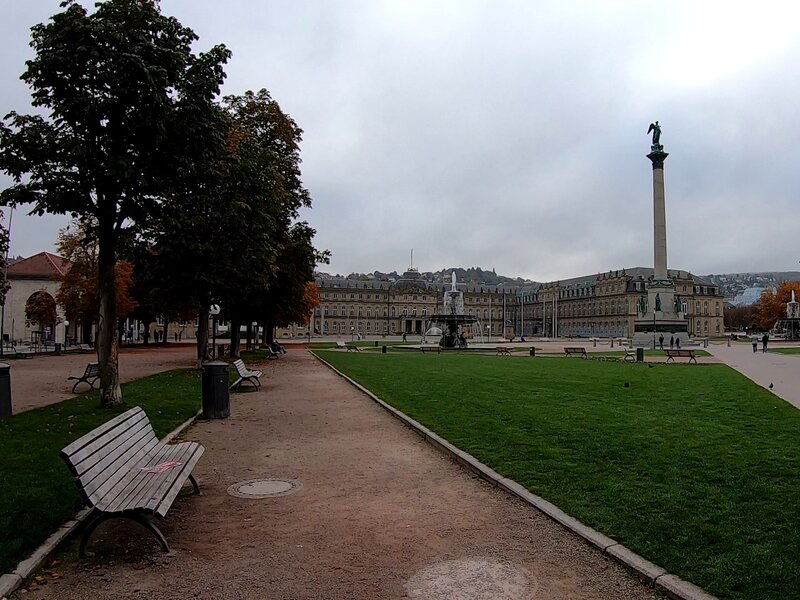
Soon the darkness was gone and the gray sky appeared in the tiny windows of the waiting room. Cops came by and booted the homeless people out of the area. The trains on the departure screen were becoming more and more frequent. It seemed the day was getting underway. Although it was still cold outside and nothing was probably open, I thought I’d walk around and see Stuttgart, a city that I hadn’t even known existed before yesterday. Not far from the station, there was a central square with a nearby park, but hardly anyone was around. The main streets were also pretty much empty with none of the shops open. I wasn’t too sure how I’d pass the time until 3:00PM. It just felt like forever away, and the city looked so unfamiliar and dull. I just sat on a bench near a palace in the central square. What was even here? I looked it up and found the city was a manufacturing hub for Mercedes and Porsche, and there were museums. But I wasn’t even into cars. I just walked around alone with my giant backpack.
For what it’s worth, the city gradually started waking up. Shops were being set up one by one in the cobblestone squares where church bells began ringing. Out of nowhere, people and cars showed up and slowly filled the streets. I walked and walked, stopping by random churches and marketplaces. Then I remembered I hadn’t eaten much for the past few days apart from bread and water. So I stopped for a quick bite of some sausage with curry sauce, which was supposed to be a local favorite. Anything else was too unaffordable–the rising cost was really hitting my wallet hard as I traveled west.
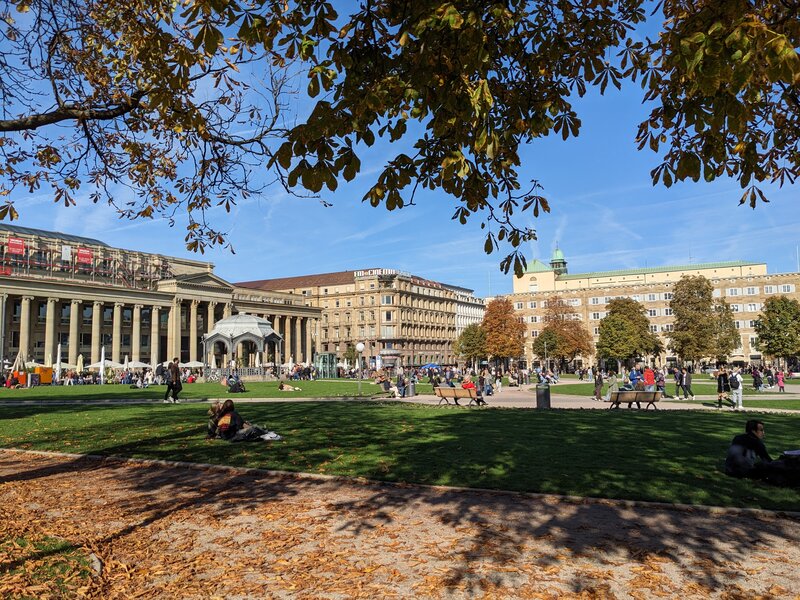
When I walked out of the cafeteria, the clouds had completely cleared up and the fresh sky greeted me. The main streets, once empty, were now overflowing with crowds visible for miles. The crisp air carried the sound of the church bells further and further, and the heartbreaking cold had given way to the pleasant autumn day. I didn’t know what to make of this sudden transformation of the city. It just wasn’t the same city that had appeared dull and empty merely a few hours ago.
The central square was now alive with vivid fall colors that screamed the peak of the season. Surely they didn’t emerge from nowhere–they must have been there all along since the morning. The only thing that changed was my perception. What other things in life was I choosing to ignore because they weren’t obvious at first glance? Maybe everything deserved a second look beyond their outward appearances. It was already nearing two in the afternoon, and I needed to head back to the station to catch the train to Paris. I walked past a sea of football fans in Stuttgart jerseys and red-white scarves, and street artists drawing, sculpting, singing, or playing instruments. I kept walking to the station, leaving the busy streets behind. I did make a quick stop at a nearby mall, though, to grab some more bread and water.
The train departed Stuttgart and picked up speed through the peaceful German countryside. With a bit of idle time on my hands, I started thinking about what I should do once arriving in London. A big question was where I was going to spend the night. I figured I’d just stay overnight in a station as I had done in Xi’an. The cheapest hostel I could find near the station was too expensive, and it sounded a bit crazy to pay that much for a bed in a dorm. But I wanted a shower and some rest, because I’d had neither since leaving Istanbul two days ago. Feeling tired, I ended up splurging 42 pounds ($57) for a bed in a 6-person dorm room for a night. While I was at it, I also booked a hostel in Dublin to rip the band-aid off cleanly. I thought about camping out at the Dublin airport but it seemed worth staying in the city to explore it before flying out.
Somehow we were in France now. The rural landscape outside the window mostly consisted of lazy grassland dotted with huge electrical power lines. I believe the scenery looked lazy not only because of its rustic charm, but also because for once in my trip, the path toward Dublin was finally certain. Without a problem to solve or obstacles to overcome, the road ahead was no longer imbued with the familiar sense of urgency or uncertainty. Rather, the grassland was just a grassland, the sky was a sky, the forest was a forest, and the railroad was a railroad. As the benevolent sunlight flooded the tranquil and hilly French countryside, I felt peaceful. Yet, for some reason, the feeling was no more comforting than the perilous thoughts of an imminent failure or helplessness of being overwhelmed by the adverse odds. Something was slightly off and confusing, and then I came to realize why.
It was the things that I feared the most, or how I chose to approach them, that defined the finish line and made it worth pursuing. Without the risk of losing the things I had put on the line, the destination ceased to be what it was. Almost at the road’s end, I finally understood the real reason I had been so obsessed with walking down this imaginary road to Dublin. It wasn’t about refusing to fall in line. What drove me was knowing I could fail spectacularly, and going anyway. Meaning didn’t exist in things, waiting to be discovered. It was choices that made it. There was a road, so why not walk? There was no point, but that was the point. Sitting still or taking the efficient path was the strange decision. So the question was backwards all along. It wasn’t about why someone would go from Beijing to Dublin in twenty-four days. The real question was why someone would not do it. I didn’t owe an explanation–not going for it would have been the thing that needed explaining.
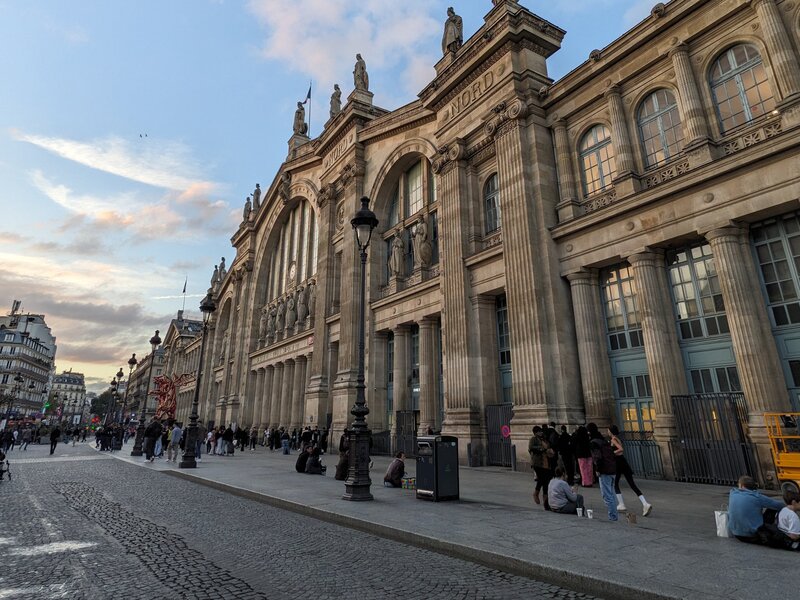
The train arrived in Paris Est station by 6:20PM. When I hopped off, I didn’t have any bearings on my location. The only thing I knew was I had to get to Paris Nord station where Eurostar was scheduled to leave at 8:12PM. At first, I didn’t even know where Paris Nord was, but the sign in the station said it was only five minutes away. There was plenty of time, but I still rushed to Paris Nord straight away. I couldn’t afford to miss the train, in quite a literal sense because the ticket cost a fortune. After a short walk, I could see the impressive facade of Paris Nord which was slightly taking on the color of the impending sunset. Actually, it wasn’t just the station, but the entire city that was being shrouded in that orange tension between the coming night and the last glimmer of the daylight. All the streets and buildings, confused and indecisive, were blushing in a faint color of the sunset. I stood around a little bit on the cobblestone street in front of the station just to humor myself for a bit, said goodbye to the city to conclude our brief meeting, and walked into the station.
It didn’t take long to clear the passport control and the security check, and I was sitting on a bench in the departure hall in no time. Through the small windows on the side, the last traces of daylight were disappearing over the city streets. I wanted to be among those streets and lights, but couldn’t break the plan this time. This wasn’t Budapest, and I had come too far and too close to the final moments to drop everything and listen to my heart. The road itself is sometimes more important than what we see along the way. After a while, there was a loud boarding announcement, and I went down to the platform and got on board. Next stop, London.
The train ride was only slightly longer than an hour, but I was impatient for the whole ride. Mostly I needed a shower–I hadn’t had one since Istanbul. It was like I was back on the train from Urumqi to Kashgar, after not having had a chance to tidy up since Beijing. The train kept on moving. The speedometer on the ceiling was showing some high number, but it didn’t feel like we were moving that fast. All I could see outside was the dark and monotonous background of the tunnel. I tried to read a bit but couldn’t really follow the book. The last time I had any sleep was when I left Bucharest two days ago. I just stared at the dim background and the occasional white light passing by the window.
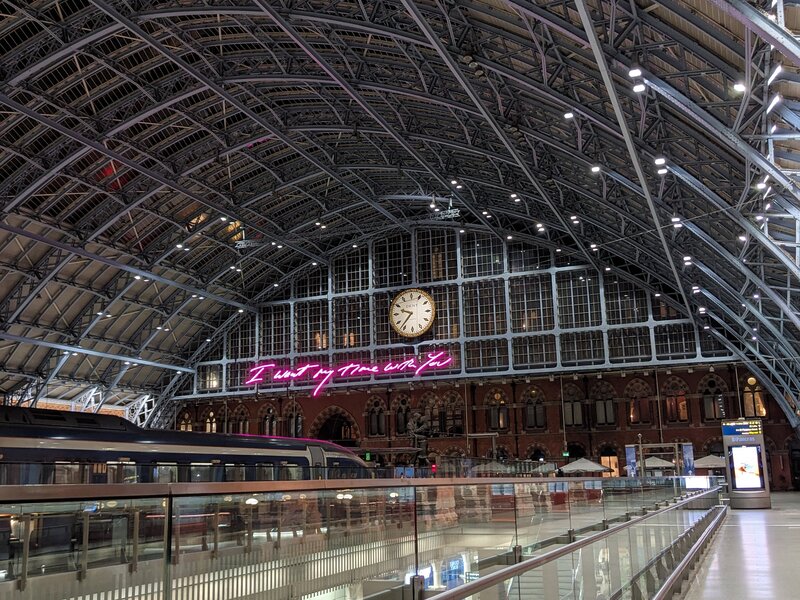
The train arrived at St. Pancras station in London at around 9:30PM. Walking down the platform, I was again befuddled by the little things that had been changing so rapidly over the past few days. All the signs in the station and the shopfronts, once in Hungarian, German, and French, were now in English. There were numerous other little things that inundated my senses, although I couldn’t quite put my finger on them. Smell? Temperature? The familiar English language from the loudspeakers? I was too tired to make much of them, anyway. There was nothing much to see or do near the station at night, nor did I have any energy left. I slowly walked to the hostel, navigating the unfamiliar, dark streets of the new city. It was already close to midnight when I managed to unpack, take a shower, and grab a bite to eat.
The next day was the day that I would finally reach Dublin. This realization was more intriguing than exciting. It made me curious, not so much about what was there in Dublin, but about what it would really mean to get there and how I would feel about it. Put simply, was it all worth it? Would my undertakings, insofar as they were inherently meaningless, come to bear some significance? I thought I was well aware of the pointless nature of my trip. I thought I was fine with it. But suddenly the answer felt terrifying. This was no longer a daydream, and Dublin was no longer just an abstract destination. Now that it was within my reach, I was afraid to take the last step. Tomorrow I’d find out whether the past twenty-four days were really for nothing, and live with the conclusion, with no more road left to follow.