My only day in Tbilisi was also my last day in the Caucasus. So I started the day early, although I had no idea what to do. I was going to roam all day because a mammoth bus ride toward Istanbul was waiting for me the next day. Spending thirty hours confined on a bus didn’t sound too fun, and I wanted to savor the freedom to walk around while I could.
Tbilisi’s slumbering stillness, however, didn’t quite match my eagerness to explore. The city just didn’t want to wake up, comfortably tucked under the blanket of the thick clouds above. Last night, the main avenue leading to the main square was so full of traffic that it was impossible to cross. In the calm of the morning, however, the same avenue was so empty that it felt as though I had woken up in a different city. In the daylight, I noticed other things as well. The walls along the streets were full of paintings of European Union flags with some Georgian writing. While I couldn’t understand the meanings of the cryptic Georgian script, the surroundings gave me some idea about what they were about. Many buildings were flying the flags of the European Union and Ukraine on their balconies. Crude graffiti wasn’t shy about condemning the ongoing conflict. There were more of those than I had realized last night.
As the lazy city reluctantly awoke from its snooze and the sky cleared up, the churches on the streets started broadcasting peaceful hymns sung in solemn voices. At first, I thought those speakers outside the churches were playing some recordings. But when I took a glimpse into a chapel, it became apparent that it was the morning churchgoers who were actually singing those hymns. It was only at that moment that I realized it must have been Sunday. The days of the week had already lost their meaning to me. The only measure of time that I found relevant or cared about was the number of days I had remaining to reach Dublin–eight days.
I stopped for a while and listened to the soothing harmonies of the choirs reverberating through the sleepy streets. I was happy to take a few minutes and just do nothing but listen. A different sight, and a different feeling. I really had come far. Maybe following a road means peeling away the layers of distance and discovering what lies at its core. The distance between Baku and Tbilisi started off as an abstract concept removed from reality–something that only existed on a map. As I actually covered that distance, it had become something tangible–roads, railways, earth, and everything that physically composed it. Across that distance, there were new cultures and ways of life. What was once unfathomable had become a real thing that could be felt and understood.
This transformation wasn’t specific to the distance between Baku and Tbilisi, but had been there all along ever since Beijing. People’s appearances, languages, weather, architecture, or even the smell of the air kept changing. If those changes meant anything, maybe the meaning wasn’t in the novelty, but in the metamorphosis of the theoretical into palpable experiences and feelings. Would I find the meaning of my footsteps at the end of this transformation? I followed the mysterious sound of choirs that filled the various parts of this spiritual city. Surrounded by unfamiliar icons and the soothing chants of words incomprehensible, I became as excited as I was when I first saw the extraordinary mosques in Central Asia. The river glistened peacefully. All the clouds had already disappeared and the sky was as clear as glass.
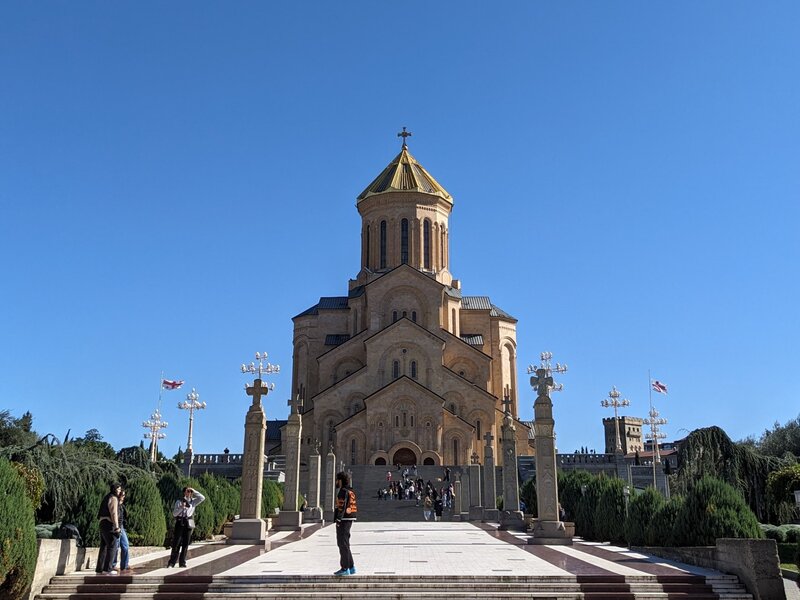
It was already well past noon when I was done hopping from one Orthodox cathedral to another. Tbilisi was hilly, and my legs were hurting from walking around all morning. But I’d have all the time in the world to sit around the next day during the bus ride. So I decided to climb the hill in the southern part of the town to check out the Mother of Georgia statue. There were cable cars, but the prospect of sitting in a moving cube sounded too easy. So I started walking the winding roads to the top. The path was mostly unmarked, but I was able to follow some other people who were also going upward.
The Mother of Georgia was looking down on me from the edge of the hill when I was about halfway up. It was a statue of a female figure looking over Tbilisi while holding a sword in one hand and a bowl in the other. In many ways, it reminded me of the similar Soviet-era statues such as Mother Ukraine. It was an immortalized female personification of the motherland that called upon the citizens of the empire long gone. She stood tall, stirring national pride with her firm yet affectionate watch. Her presence rang with a faint echo of Georgia’s distant Soviet past, which was generally hard to notice in Tbilisi.
On the top of the hill, I stood around where she was standing and watched the old city and the autumn sky now so blue and crisp. Nearby, a musician was playing an electric guitar. I almost never stop or pay attention to street musicians, but at that moment, something about the progressive melody overwhelmed me. I just stood there and zoned out, my thoughts lost in the flawless sky and the peaceful sound of the guitar. I didn’t see the point in learning who the musician was. The experience was so full that anything extra would have ruined it. I just walked away when I finally came to my senses. When I walked around a bit and returned to the trail to go back down to the city, the guitar player had disappeared as if he hadn’t even been real.
After that, there were many places to go, but I just lacked the motivation or imagination to choose. So I just walked. By chance, I ended up near a sea of sulfur bathhouses in the old town. They were mostly fancy-looking and expensive, but there was this no-nonsense place that had supposedly been standing since the Soviet times. You can probably guess who was intrigued by that piece of history and the unpretentious charm of the place. The admission was only 10 lari ($3.50) if I brought my own towels and slippers. I decided to return in the evening with my stuff. Relaxing in a Soviet bathhouse sounded like a great way to end the day in Tbilisi and prepare for the upcoming sprint to Europe. For the rest of the afternoon, I aimlessly walked along the river toward the north, against the traffic. At some point, I ran into a flea market where people were trading old relics and interesting memorabilia, but it was already wrapping up. The evening was approaching quickly.
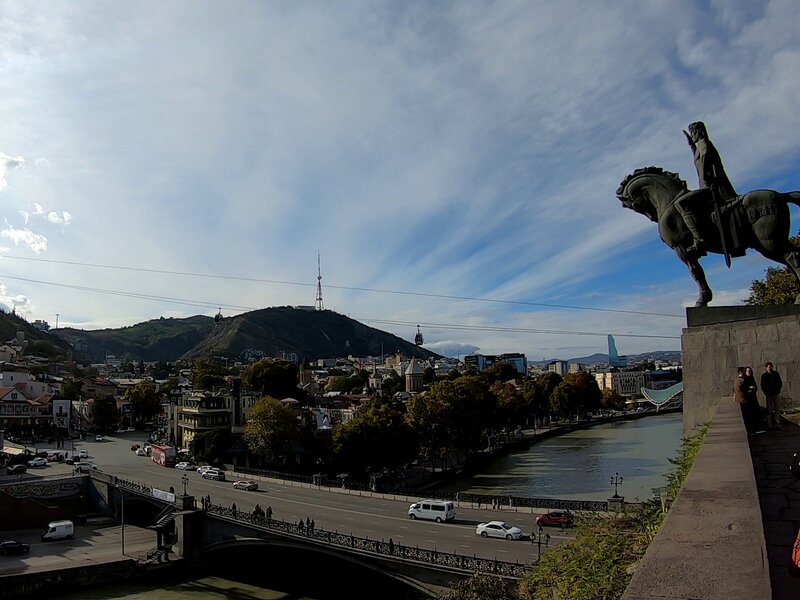
At the hostel, I grabbed what I needed for the sulfur bath and headed back to the old town, wondering what the experience would be like. On the way, there were many people on the sidewalks selling European Union flags. It was pretty random but I didn’t make much of it at first. I was busy thinking about what to have for dinner, and I knew just the thing–khinkali. It’s a Georgian dumpling dish that Gunn had recommended. As I tried to find a restaurant that didn’t have a giant queue outside, I kept noticing police officers hanging around random streets and blocking the traffic. I again didn’t make much of it and assumed it was a routine procedure for a touristy downtown area. I finally sat down in a restaurant and tried khinkali, which turned out to be very similar to xiaolongbao, a Chinese soup dumpling. It was surprising to see two distant cultures converging on a recipe so similar.
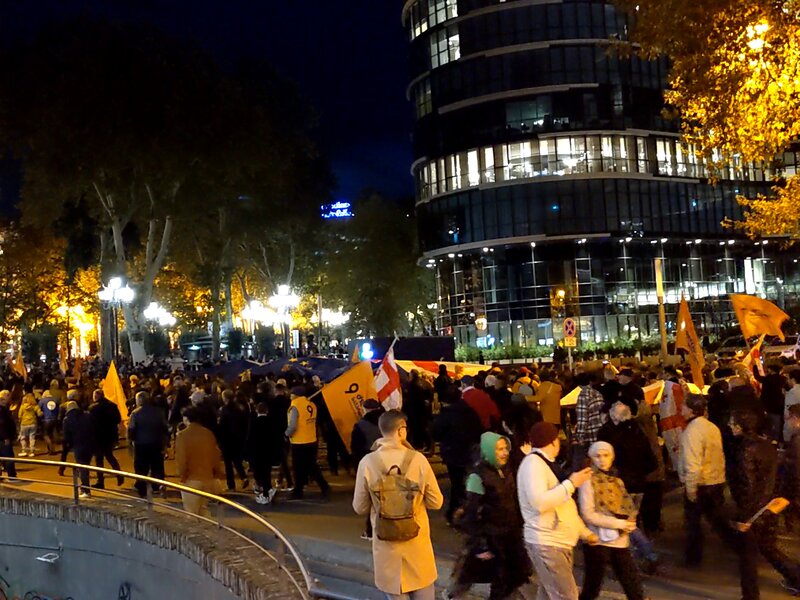
When I walked out of the restaurant, the streets had grown dark and an endless crowd of people was marching down and chanting words that I didn’t understand. Not knowing what to make of this sudden development, I asked a girl who was standing nearby what was going on. There was a bit of a language barrier, but she explained that people were angry about the government’s stance with Russia. She soon disappeared into the marching crowd, but not before leaving me with a comment that transcended the linguistic divide: “People are fighting for their future.”
Many of the protesters were carrying or wearing flags of Georgia and European Union. The strange things I’d noticed now fell into place–the paintings on the wall, graffiti, people selling the flags, police officers blocking the roads. They had been leading to this protest. The streets, peaceful merely an hour ago, were now running wild with marching people and their roaring chants. All the roads were practically unwalkable and there was no obvious way to get to the old town. I slowly pushed through in the opposite direction of the crowd from the main square. I had edged in that direction for around twenty minutes before the crowd started to thin out and there was room to get off the main avenue. The echoing oration from the loudspeakers and the cheers of the crowd were heard all the way to the bathhouses in that long detour.
Away from the commotion, all the sulfur bathhouses were sitting quietly in the corner of the old town. When I walked into a brick entrance, a lady behind the glass window looked up blankly, collected the admission fee, and wordlessly pointed toward the basement. Everything in the place was so basic and had zero room for any kind of frills. A bunch of old metal lockers and narrow benches were lining the walls of the locker room. The air was full of the pungent and earthy smell of sulfur. Whenever the door leading to the public bath opened, it belched sulfuric steam along with the wet sound of liquid slapping the ceramic floor. The crowd was mostly local grandpas and middle-aged men, but there were also a couple of curious travelers. In the public bath area, there were a bunch of open showers where bare plastic pipes let out a crude flow of hot sulfuric water, stone benches where people could lie down, and the main bath under a mosaic-covered dome. Even the patterns of the mosaic were simple and efficient. I had expected the bath to be scalding hot like those in Korean bathhouses, but the water was just hot enough and easily bearable. Immersed in the sulfuric water, I felt relaxed for the first time in a while. I felt prepared to take on the road to Istanbul and beyond.
All the recent memories of struggling to reach this point flashed in my mind. It was merely a few days ago that I walked all day in Bukhara and returned to Tashkent on a night train. It hadn’t been that long since I caught that 3:20AM flight to Baku. Wondering how I had been able to get through all that, I just sat in the water and listened to the silence which was only interrupted by an occasional splash of overflow or a running shower.
“Otkuda?” (“From where?”) suddenly a grandpa who was also sitting in the water started talking to me. “Ya iz Korei” (“From Korea”). He then asked whether I hailed from Seoul. I didn’t want to get into the whole backstory of being a Korean Australian, so I kind of went along and said yes. Apparently, he was born in Georgia. I tried to ask whether he had been coming to this bathhouse for a long time, but he didn’t understand my poorly phrased Russian. “Ya yezzhu na Koreyskoy mashine” (“I drive a Korean car”), he said, trying to say something nice. I wasn’t sure how to respond and just politely laughed. Besides our chat or the splash of water, something else regularly broke the silence. Sometimes, the guy in charge of the locker room would open the door and shout something in Georgian. It looked like he was keeping track of the time but I had no way of understanding him. In any case, I left the bathhouse after about an hour because I had to plan for the coming days.
Smelling like an aged egg from the sulfuric bath, I took the detour back to the hostel. It was already past nine o’clock but the protesters were still heard, their sounds only growing louder as I approached the city center. The main square was still full of people. An orator was giving a passionate speech into a microphone, and people cheered whenever he finished a sentence. When the speech concluded, some performers began playing and singing Georgian pop music, energizing the crowd. At one point, the band said something and started playing a certain melody, and everyone around me, walking or standing, immediately started dancing and singing along as if on cue. The song must have been a massive Georgian classic. I was the only one who didn’t know the words to it and didn’t participate in that instant rite. As everyone took part in that unspoken ceremony of belonging and shared identity, I walked alone in silence against the sea of people, in the opposite direction. And at that moment, as I felt the cultural divide that placed me outside the rhythm of the place, I was glad. Only in those moments of discord and isolation can I truly witness the great transformation of abstract distance into something concrete, and feel its realness leave a mark on how I see the world.
Back at the hostel, I grew excited as the last night in Georgia wore on. It was a big deal to be finally heading to Istanbul, because I would have crossed the Silk Road by the end of it. Daydreams were becoming real. The imaginary roads were taking on a concrete form. The thirty-hour bus ride still worried me. It was like that night at the Xi’an station when my imagination about the twenty-six-hour train trip ran wild. The bus ride was even longer and probably more uncomfortable because I couldn’t lie down. I hoped the bus would at least have some nice seats. But then, I thought about the caravans that must have faced far harsher conditions and made even greater sacrifices to cross the same road. All my worries suddenly seemed rather trivial. I stopped worrying and began to appreciate the significance of the upcoming trip. The caravans probably didn’t have reclining seats on their camels.