The stretch of land between Baku and Tbilisi used to be nothing more than a line on a map. But it was now as real as the steel, the concrete, and the dirt that actually made it up. All my abstract worries about how I would reach Georgia turned into something that I had to face head-on. No more tomorrows. The meandering path from Baku to Tbilisi was around 600km (370mi), which was more than any of the routes I’d recently covered in one go–like from Kashgar to Osh or from Bukhara to Tashkent. I couldn’t afford any delays because there were only nine days left to reach Dublin. The train was due to arrive in Aghstafa at around 3:40PM, and I had to find transport to Red Bridge, which was the border crossing between Azerbaijan and Georgia. Afterwards, I needed to find my own way to Tbilisi. I didn’t know how to cover those final 100km (60mi) from Aghstafa to Tbilisi but I just needed to go.
I awoke, no alarm needed. From the window, Baku in the morning was gloomy as it had been for the past two days. Heavy clouds hung over the city, filling it with moist air that certainly hadn’t helped my last-minute laundry dry overnight. 7:00AM. My train was due to depart in two hours and the timing was awkward to go out for breakfast. I sat down at a small corner table and munched on some leftover bread from the night before while thinking about the road ahead. A bit later, Gunn joined me, fully prepared to head for Sheki. After sharing some bread and chatting with some other travelers about Georgia, we checked out of the hostel.
Gunn had to take a subway to a bus station and I had to go to the Baku railway station. We walked the empty morning streets of downtown mostly in silence until our paths diverged. “Take care of yourself, bro,” he said. Remembering that I had stashed away some snacks in my pocket for the train ride, I shared some with him for his long bus trip. “Take care of yourself too,” I said. And I don’t know why, but I added, “Go to the Christmas market.” We then went our separate ways. I never did get to ask Gunn why he was going to the Christmas market, but I somehow knew the reason. Everyone was ultimately on this road because they chose to be here. Maybe the choices weren’t even ours to make–the road was so obvious that one was bound to end up exactly where one was supposed to be, like a marble rolling down a slope to the base. All inevitable struggles toward our own destinations resembled one another in this way. So maybe I was really saying to myself, “Go to Dublin,” when I said, “Go to the Christmas market.” When I looked around, Gunn had already gone out of sight. The unfamiliar smell of the morning air reminded me that no one else could bear the weight of the uncertainty for me, and that the struggle to follow my imaginary roads was mine alone.
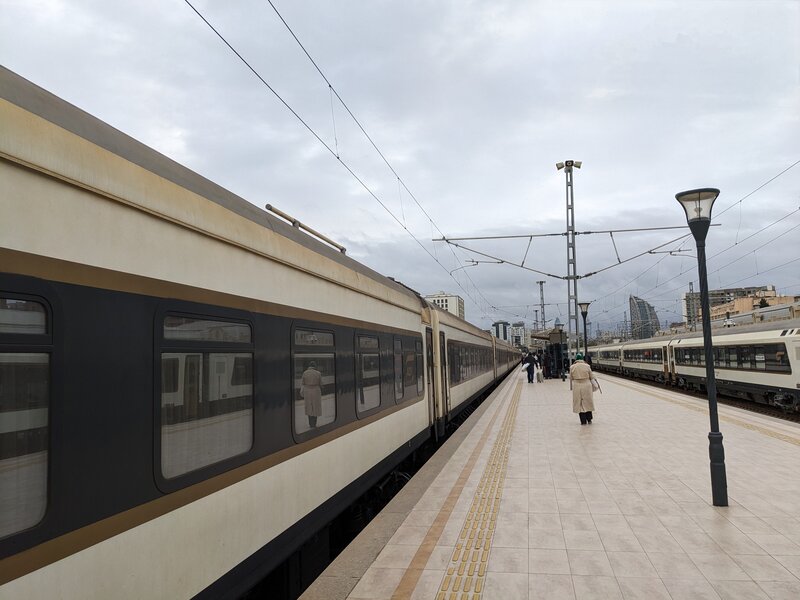
At the station, the Aghstafa-bound train was already idling on the platform, itching to bolt. I was also eager to waste no time in my sprint to Georgia. The departure was in half an hour, and passengers were gradually filling the empty seats. When the train became more or less full, a sudden jolt wrenched the train into motion. Cloudy Baku began to slowly fade behind the window curtains as the train started its great passage westward across Azerbaijan.
Once we got out of the familiar and modern Baku, the landscape outside the window changed dramatically. Everything became empty and sparse. There were boundless sandy plains, with naked mountains in the distance. The constant warm beige color of everything numbed my senses. The sand-filled wasteland, the gloomy sky above it, the interior of the train were all light yellowish brown, the same color that even dominated the walls of old buildings in downtown Baku. The warm and cheerless glow, the only constant in the shifting scenery, made the vast uninhabited stretch of land feel even more hollow. After the sandy plains, the train passed through the seemingly endless steppes where short and dry grasses were fading in red on dusty soil. All this reminded me of the lifeless desert of China’s far west, minus the sun.
The train ride felt different on this side of the Caspian Sea. The train car was modern and clean, and lacked the spontaneous interactions that happened in Central Asia. There was no Kostya, Isroil, the singing grandpa, or a guy whose phone ran out of juice. All the passengers just claimed their own space and went to sleep, with their phones and laptops conveniently plugged into the wall sockets. Without any room for drama or emotion, the metal tube quietly and monotonously carried the passengers west. After some time, the seemingly endless barren steppes disappeared, and greenery of the idyllic countryside began to fill the window. As if on cue, the sun came out of its hiding place and showed its face for the first time through the clouds, shining its blissful light on the vast green fields and farmlands. As the train continued to the edge of Azerbaijan, even the signs of country life became scarce and the surroundings gave way to open pastures and faraway mountains. Cattle were grazing peacefully as the sky cleared up even more. The train was mostly empty now. Only a few passengers were headed all the way to Aghstafa.
The train slowed and the remaining passengers began to pack up. I figured we were probably close to arriving at Aghstafa. To find out how to get to Red Bridge, I started chatting with another passenger who was standing by the aisle. His name was Raul, and he said that he was a student from Aghstafa who went to university in Baku. This was his regular weekend train ride back to Aghstafa to see his family. “You need to go to Red Bridge by taxi,” he said in English, “but be careful, they could overcharge you.” He looked up the price and made it extra clear that I should probably pay around 15 manat ($12). The train soon pulled into rural Aghstafa. “Good luck,” Raul said before going his own way. The train had run slightly late, and it was already 4:00PM.
Eager as I was to rush to Red Bridge, I was too hungry to continue. The only thing I had eaten that day was some bread and snacks. With a lot of distance left to cover, I didn’t want to take chances on street food. But there was just no time to sit down somewhere for lunch, and I grabbed a kebab to go from a street food vendor nearby while trying to order a cab. The cooks were at first very slow and didn’t fully understand my plea for urgency. “U menya taksist,” I said, “on zdes’ cherez pyat’ minut” (“I have a driver coming in five minutes”). They eventually understood, smiled, and quickened their pace.
The kebab was ready but the driver never showed. And I just couldn’t find anyone willing to take me to Red Bridge. There were a bunch of drivers sitting near the station, but no one really wanted to go all the way there. It was twenty minutes before someone willing to make the trip finally turned up. “Krasnyy most, da?” (“Red Bridge, right?”) the driver said in a businesslike manner while looking up the directions. He then explained that the border was an hour’s drive away and asked if I would be happy to pay 20 manat. “Davaite” (“Sure”), I agreed, and we started driving to the border. It took only five minutes to get out of the small township of Aghstafa, and soon we were racing down a highway surrounded by nothing but grassland. “Mozhno yest’ yedu?” (“Can I eat food?”) I asked the driver, pointing at my kebab sandwich. “Da” (“Yes”), the driver calmly replied. “Moy russkiy plokho” (“My Russian is bad”), he added after some silence. Without much language overlap, we drove mostly in silence through the empty highway now under clear sky.
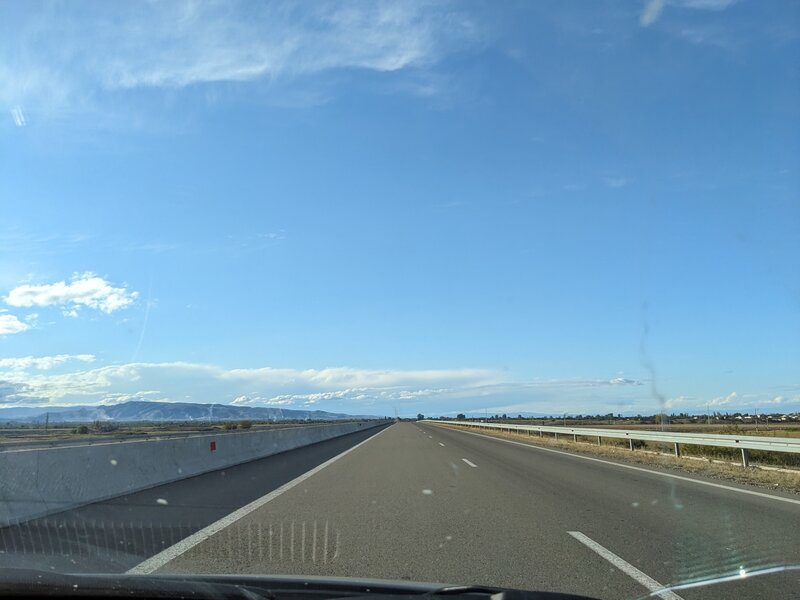
When the car slowed down and the road ahead became congested with a parade of heavy trucks, I knew that we were near the border. The driver soon stopped and said, “Vot, krasnyy most” (“Here is Red Bridge”). I thanked him and started walking toward the border gate. On that short walk, some truck drivers tried to sell me Georgian lari, which reminded me I didn’t have any Georgian currency with me. I just hoped there would be a place to get some on the other side of the border.
When I walked up to the entrance of the crossing, its large metal doors were closed and locked. My first instinct was to shake the door open. Hearing the clank, a soldier approached the fence from the inside and opened the door. “Is this the pedestrian border?” I asked awkwardly in English, and the soldier smiled and put his hand out for my passport. “Going to Georgia?” he simply asked back. After taking a brief look at the passport, he asked whether I needed a Georgian visa. I was prepared this time–I had checked ahead and knew that no visa was required. “No, Australians don’t need a visa,” I said. The soldier pointed to a narrow and long one-way corridor leading to the passport control area. “Go straight,” he said.
The passport control was pretty much empty, and there were maybe only three or four other people trying to cross the border. Some grandpas were chatting with the officials at the passport control, and a guy was standing in line with a large backpack. I hoped that some of us could split a cab to Tbilisi. But I was the last one in line, and when I cleared the Azerbaijani customs, everyone had already moved on. The first thing I saw as I walked out of the customs was the actual Red Bridge. It was an old bridge hardly visible behind a fence. The path didn’t lead to the bridge, but instead to an open area where a large Georgian flag was flying tall against a nearby hill. The hill had a sign that read GEORGIA. As I stopped in the middle of the road to take a good look at the hill, a soldier approached me and asked for a passport. After flipping through the passport, he turned back and exclaimed to his colleagues, “Australia!” Maybe not many Australians had come through there recently. He then told me to go to a small building next to the vehicle crossing.
Inside the building was Georgian customs. The glass partition at passport control had a small sticker showing the European Union flag. I didn’t recall seeing that in Azerbaijan. It felt like a sign that I was closing in on Europe, and on Dublin. There was hardly anyone waiting in line, and I was officially in Georgia in no time. “Welcome to Georgia,” the customs officer said, as she handed over my passport.
On the Georgian side, I bumped into the grandpas who were in line right before me. They were standing by the roadside with their baggage, probably waiting for transport. “Zdravstvuyte” (“Hello”), I greeted them to see where they were headed. We all shook hands, and they asked with smiles, “Otkuda?” (“Where are you from?”) I said that I was from Australia and that I wanted to go to Tbilisi. The friendly grandpas seemed to find it interesting to meet an Australian and told me that, unfortunately, they weren’t going as far as Tbilisi. The daylight was slightly fading, either due to the clouds or the upcoming sundown. In any case, the fading daylight curbed my celebratory mood and added urgency to the remaining trip to Tbilisi. I needed to press on before the night came.
Right outside the border, there was only an empty highway in front of me. I briefly thought about just walking, but it felt reckless given the falling dusk. Besides, it wasn’t long until some locals who were hanging around in the area stopped me and asked, “Taxi?” “Skol’ko?” (“How much?”) I asked. “Kuda?” (“Where to?”) I hadn’t actually booked any accommodation at this point, so I just said, “Tbilisi, tsentr goroda” (“Tbilisi, city center”). Some of them offered to drive there at 120 lari ($43). Not used to the new currency, I wasn’t too sure how much that was, but tried to bring it down a bit and offered 80 lari. No one was willing to take the deal, insisting that the gas was too expensive to justify the trip. There was only one man who was willing to come down to 100 lari. “Davaite, vosem’desyat lari” (“Let’s do 80 lari”), I attempted to negotiate, trying hard to remember how to count correctly in Russian and not to mix up the numbers. “Tol’ko do tsentra goroda, davai” (“Only to the city center, let’s go”), the driver said, and we shook hands on 80 lari ($29). I didn’t know whether it was a fair price, but I was eager to move on and not get stranded in the middle of nowhere at night.
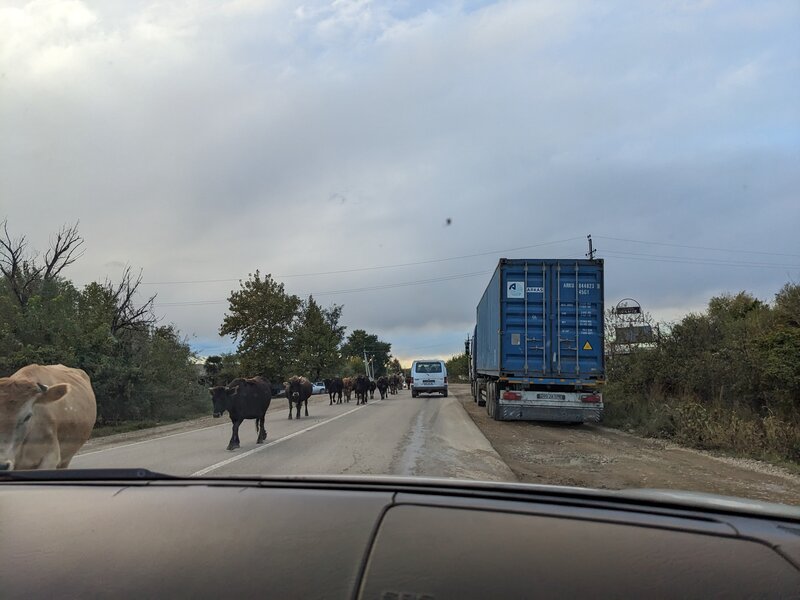
As the evening Georgian countryside rolled by the window, my mind was finally at ease for the first time all day. I was going to make it after all. The winding country road passed through the peaceful grass hills and the shrublands dotted with occasional trees. One time, the car had to pull aside to make way for a group of cows that were marching down the road. It was hard to imagine that there were any big cities beyond this pastoral land. But when we reached the highest point of the hill, a distant panorama of a large city packed with medium-rise buildings came into view, an urban jungle sprawling into the surrounding grasslands. The city wasn’t Tbilisi–the road sign said something different–but we were getting closer. The driver still seemed a bit unhappy about the fact that I’d haggled down the fare. When I told him that I had found accommodation, he simply said that he would only take me to the city center, which was what we’d agreed on. “Da, soglasen” (“Ok, agreed”), I said because technically he wasn’t wrong. “Da, togda u nas problem net” (“Ok, then we have no problems”), he said.
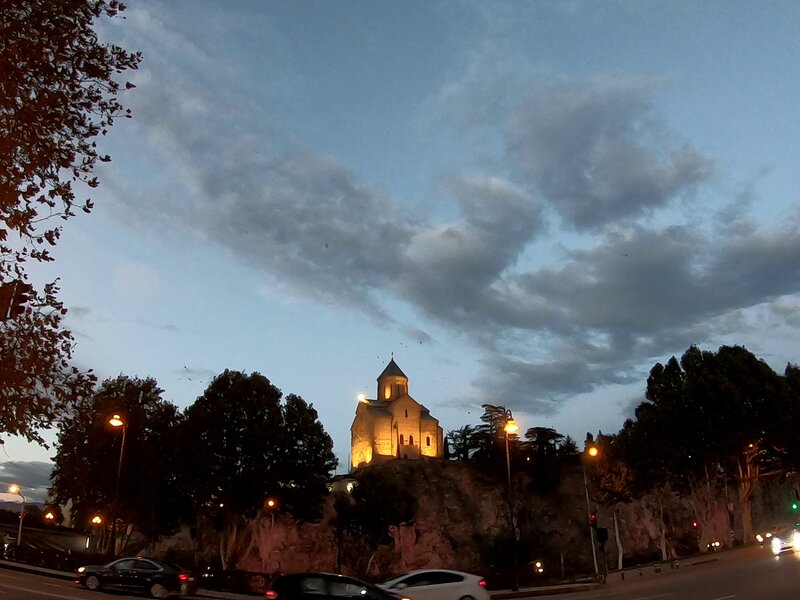
It was almost seven o’clock when the car finally arrived in Tbilisi and dropped me off on a roadside. The city was steeped in dusk, and the orange street lamps were already lighting the streets full of night traffic. Having no sense of direction, I asked the driver where the city center was. He pointed toward the direction along the river and said that I would find “Meidan” there. I didn’t know what it was, but the driver had already taken a sharp U-turn and gone back. It was disorienting to find myself in the middle of heavy night traffic in a new country. Hoping to get away from the busy road, I diligently walked in the direction the driver was pointing at. Not far away, there was a church overlooking the river from a hilltop. It was the first time I saw a church since the trip began in Beijing.
Following the river, I finally walked into what appeared to be the old part of the town. Everything was less perfect than Baku’s old town. The unkempt sidewalk was full of signs advertising deals, power poles were covered in graffiti and posters, and leaves and litter were scattered across the cobblestone streets. All the advertisements for tours and mobile phone plans suggested I was in a tourist hotspot. But I didn’t mind the rough first impression of Tbilisi.
Since my hostel was around a thirty-minute walk away, I decided to have something to eat first. When I told Gunn the day before that I didn’t know anything about Georgia and that I probably had no choice but to rush through it, he recommended that I at least try some khachapuri and wine. I walked into a local restaurant and ordered one basic khachapuri and a glass of white wine. While I was waiting for the order, something peculiar about the surroundings caught my attention. Although none of the signs or menus in the restaurant were in Russian, many staff and guests were speaking Russian. I figured Russian was also spoken here as a minority language, and many Russian tourists probably came here.
Still, downtown was full of graffiti and flags that hinted at the tension between the two countries. This mixed observation left me puzzled. Walking past all the swanky hotels of the city center, I made my way to the hostel to conclude the long day. There was another guest who was checking in before me, and the staff, upon seeing her passport, started speaking Russian. When it was my turn to check in, I asked the staff how he knew the language. He shrugged and said he just did, even though he was born here.
After unpacking and getting settled for the night, I ended up randomly chatting with other travelers. Seeing the diverse group of backpackers, I realized that I was now following the well-traveled route. This was no Xinjiang or a small Central Asian city–without realizing it, I had walked into a sightseeing hotbed. There wasn’t anything wrong with it, but I wished I had more time to stop at places where there were opportunities to discover things on my own. It was wishful thinking, of course, and I was feeling the squeeze of time.
Well past midnight, I planned for the coming days. There was an Istanbul-bound bus leaving Tbilisi at 9:00AM the day after. The thirty-hour bus ride sounded punishing, but I booked a ticket to get it out of the way. It felt like a huge weight was lifted off my mind–at least, the path to Istanbul was now clear, although I had no idea what would come after I got there. I also spent many hours trying to plan my path from Istanbul onwards, but I couldn’t navigate the enigmatic and fragmented Eurail booking system while being sleep-deprived. From what I could gather, it sounded like a Eurail pass could save me some time and headaches. So I pulled the trigger and bought one, hoping the decision was right because it wasn’t cheap. Planning the European part of my trip was exciting. I had really made it all the way here. The memories from the beginning of my trip and all the intense doubt that used to consume me all felt so distant.