Through the night, the train sped across northern China and was rapidly approaching Xi’an by early morning. The overcast morning sky, stretching over the vast land and distant mountains outside the window, stirred my imagination about what lay ahead. The main thing I wanted to check out in Xi’an was the Terracotta Army. The constant mentions of them in history classes and popular culture made it sound like a big deal, so I figured, why not see it. The train rolled into the massive Xi’an station. Since I planned to spend the night at the station later, the first thing I did upon arrival was look for a suitable place to sleep. But everywhere was incredibly busy, and there were just hard concrete floors. I saw some people lounging on folded cardboard boxes, but I wasn’t sure whether I could pull that off. Problem for later, though. There was a whole new city to explore and an entire day ahead.
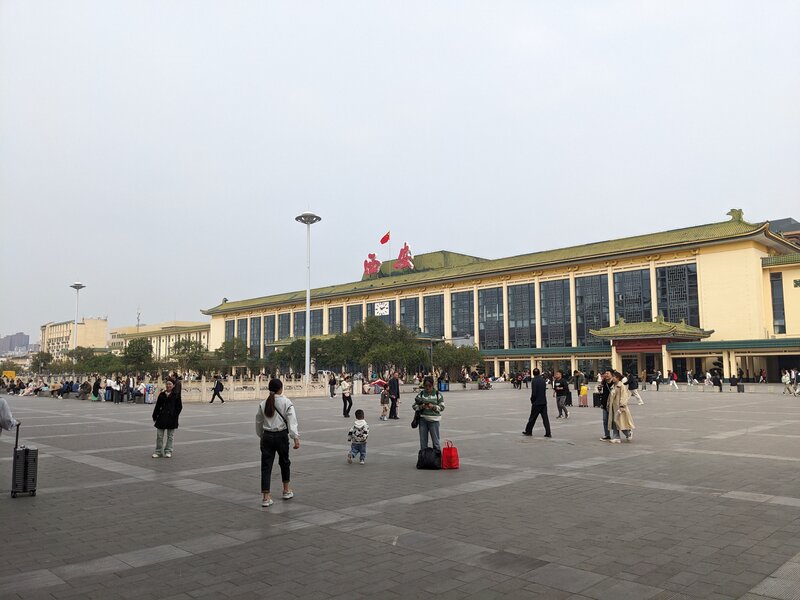
First thing, drop off the backpack. I wasn’t going to repeat the mistake of carrying it, like I did at the Great Wall. The station staff didn’t understand a word of English, but my clumsy attempt at miming a man putting a bag inside a locker and closing the door seemed to do the trick. They laughed and pointed me to the station entrance. Not knowing whether the point got across, I followed the direction and did the same mime for another staff to confirm. At the luggage storage, the clerk didn’t understand English, so we communicated by writing down numbers on a scrap of paper for the duration and the price. I paid for twenty-four hours, and the clerk took away the backpack.
Xi’an felt very different from Beijing. It was already bustling with morning activities, but was far less chaotic compared to the pandemonium in Beijing. I walked around the main streets just outside the Xi’an city wall. It was comforting. Seeing all the restaurants made me kind of hungry, and I knew what I wanted to go for–I needed to try Jajangmyeon in China. It’s basically a Korean-Chinese dish of dry noodles topped with thick black gravy and ground pork. It is widespread in South Korea but originated in China. Having grown up eating that, naturally I wanted to know how the real deal tasted. As my luck would have it, so many restaurants were serving Jajangmyeon. I picked a humble place near the station and ordered a bowl. Nibbling, I looked up the transport to the Terracotta Army.
The Terracotta Army was actually far away from the city and would take at least a one-hour taxi ride. But I didn’t want to shell out money for a taxi. Besides, I wasn’t in a rush as I had the entire day. So I decided to take a subway to the outskirts of town and transfer to a bus that would take me there. Near the train station, there were so many tour operators selling packages, shouting “Bingmayong!” which I guessed was how to say the Terracotta Army in Mandarin. I went up to the desk of one of the operators out of curiosity and greeted her in English. The clerk turned visibly offended and barked at me to speak Mandarin. An English-speaking Korean traveling in China seemed to be too bizarre a concept, a perpetual source of confusion.
After around two hours on the road, I arrived at the “Bingmayong.” The army was supposed to have been buried to protect the nearby mausoleum of Emperor Qin, which was built as an actual city. Walking around the city walls, I thought about the boundless ego of mankind and how quickly it becomes irrelevant in the passage of time. When the emperor built the city and an army of warriors to serve him in the afterlife, little did he foresee that the mighty army would become antiquated, and his magnificent city would come to ruin. Maybe the arrogance comes from our inability to place ourselves in the larger timeframe beyond life. Anyway, I couldn’t find the actual mound that marked the tomb. All I could see was a mountain. It was not until later that I realized the mountain was actually the tomb.
When I left the mausoleum, it was around five o’clock and things were already closing down. With legs hurting and nothing to do, the city center was the only place left to go. The bus was packed, so I stood in the middle. Then something on the windshield caught my eye: flags of the Chinese Communist Party with a hammer and sickle. Even after three days here, it was a culture shock to see the symbol openly and casually displayed. I didn’t remember seeing any hammer and sickle even in some former Soviet countries. Fascinated, I stepped toward the front of the bus and took a picture, and all the passengers including the driver looked at me like I was a madman. I said to the driver, as if to justify my silly action, “It’s interesting.” I wasn’t sure if he understood why it was interesting to me, or even what I said. But he didn’t seem to care much either way. It was already dark when a bus and a subway ride eventually took me back to Xi’an station.
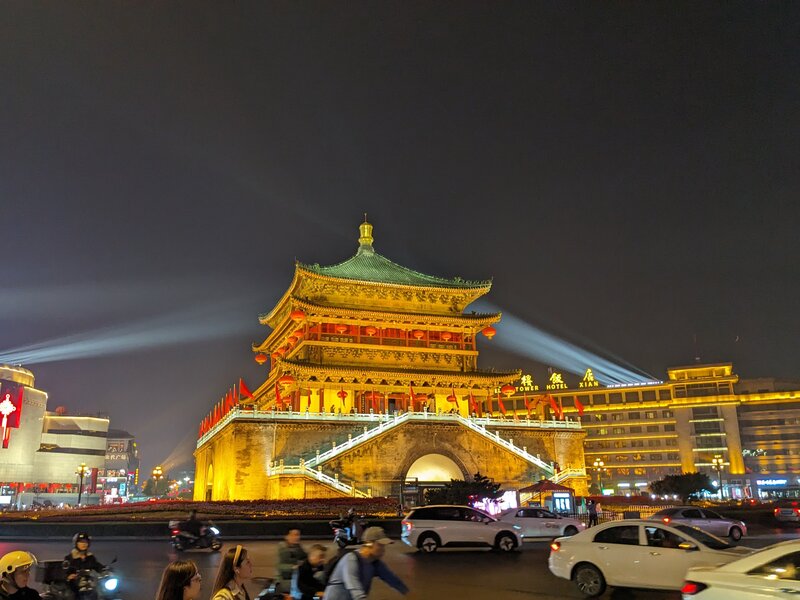
The evening in Xi’an was full of life and charming. Having recovered from the chaotic state of mind from the beginning of the trip, I was able to appreciate its beauty and interesting details. For example, I began noticing that people’s appearances and culture were slightly changing. There were many people that wore religious attire and often had darker complexions than other Chinese people. I figured they were the local Muslim population. In fact, there was even a mosque nearby. It was built with the traditional Chinese architecture style and was unlike other mosques I had seen. This was the first of many times I would observe the changing environment as I headed west. Another interesting thing was a Chinese-Russian store selling Russian stuff. It was loudly playing an upbeat Russian folk song, and all the signs were in both Mandarin and Russian. There were cute drawings of bears waving and all that. There was the same store in Beijing the other day–it seemed to be a thing here.
As the night deepened, the temperature dropped noticeably and things started closing down. My train to Urumqi wasn’t until 4:50AM the next morning. With nowhere to go, I felt lost in a way that I had never felt before. Everyone around me seemed like they had a place to go, busily talking on the phone and walking around with purpose. I was the only one who didn’t know what I was doing. So I went back to the railway station and randomly started walking in one direction from there. The night stroll wasn’t pleasant anymore. The modest charm of the city had faded behind the cold veil of night, and everything now looked unwelcoming. I retreated to the station and got to the departure hall. At least, it wasn’t really busy there, probably because the holiday week was almost coming to an end.
I sat on a bench near the departure board and started passing the time. Time crawled. By midnight, the air around me was heavy and still. Most people who were sitting around had already moved on, and the departure board that was once full showed almost no trains. I got up and changed into a pair of sweatpants to get more comfortable and tried to freshen up by brushing my teeth awkwardly in the decrepit station bathroom. Then I found a quieter area and tried unsuccessfully to sleep for another hour. Spending the cold night on a station bench was tougher than I’d imagined. I hadn’t showered since the morning of leaving Beijing, my stomach hadn’t stopped churning since the first day in China, and I was chafing from walking around in my jeans all this time. But strangely, I was okay with that and all I could think of was the road ahead.
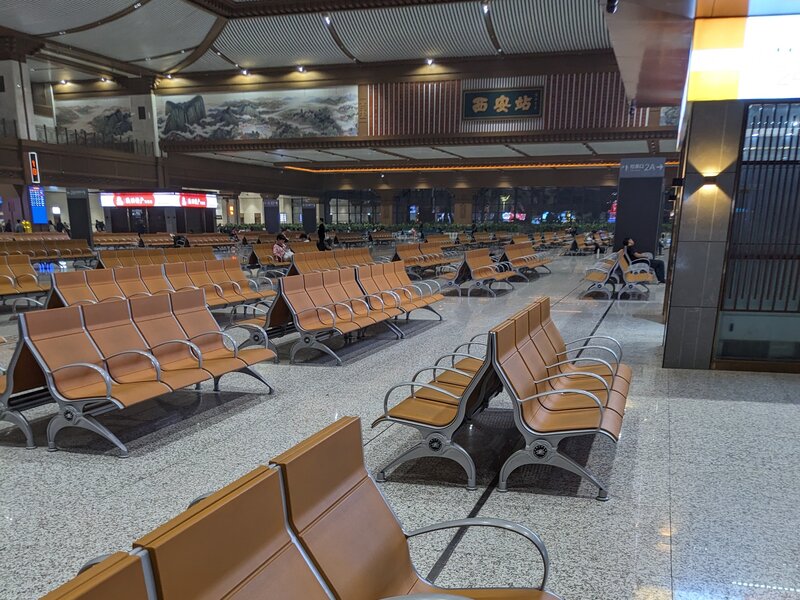
Slowly, the night passed and the seemingly unending silence was starting to get interrupted by mild activities and occasional boarding calls. When the boarding finally started for my train to Urumqi, a small queue of people formed at the gate. After the usual identification check, passengers were allowed on the platform where the train was sitting in the frigid morning air. I tried to find my carriage to escape the cold and get to bed. But there was a problem. My ticket didn’t say anything about the carriage or the seat, and the conductors couldn’t find my name on their record. Since the train was leaving in less than ten minutes, I was running up and down the platform to talk to different conductors. Some of them would tell me to go to a certain carriage and when I got there, whoever was there wouldn’t be able to find my record. This went on for a bit until eventually one of them waved me onto the train and told me to wait in the corridor until they figured out what was going on. Shortly after the train departed, and I realized that I was just being dumb and hadn’t looked at the ticket carefully. My seat number was right there on the ticket in smaller print.
I went to my cabin where some people were already sleeping. An attentive conductor helped me make the bed in the lower bunk, and I immediately fell asleep. I had twenty-six hours until Urumqi and had no idea what I was in for. The prospect of being trapped in a train for that long unsettled me. But after the exhausting two days, the narrow bunk bed felt like a paradise.